
If you’ve been in the business world for more than a minute, you’ve seen the pattern. A new technology bursts onto the scene, usually accompanied by a mix of breathless evangelism and existential dread. We saw it with the internet, mobile, and blockchain.
Now, we are in the thick of it with Artificial Intelligence. But having spent the last decade observing how technology actually integrates into corporate workflows as opposed to how it looks in a PowerPoint deck, I can tell you this time feels different.
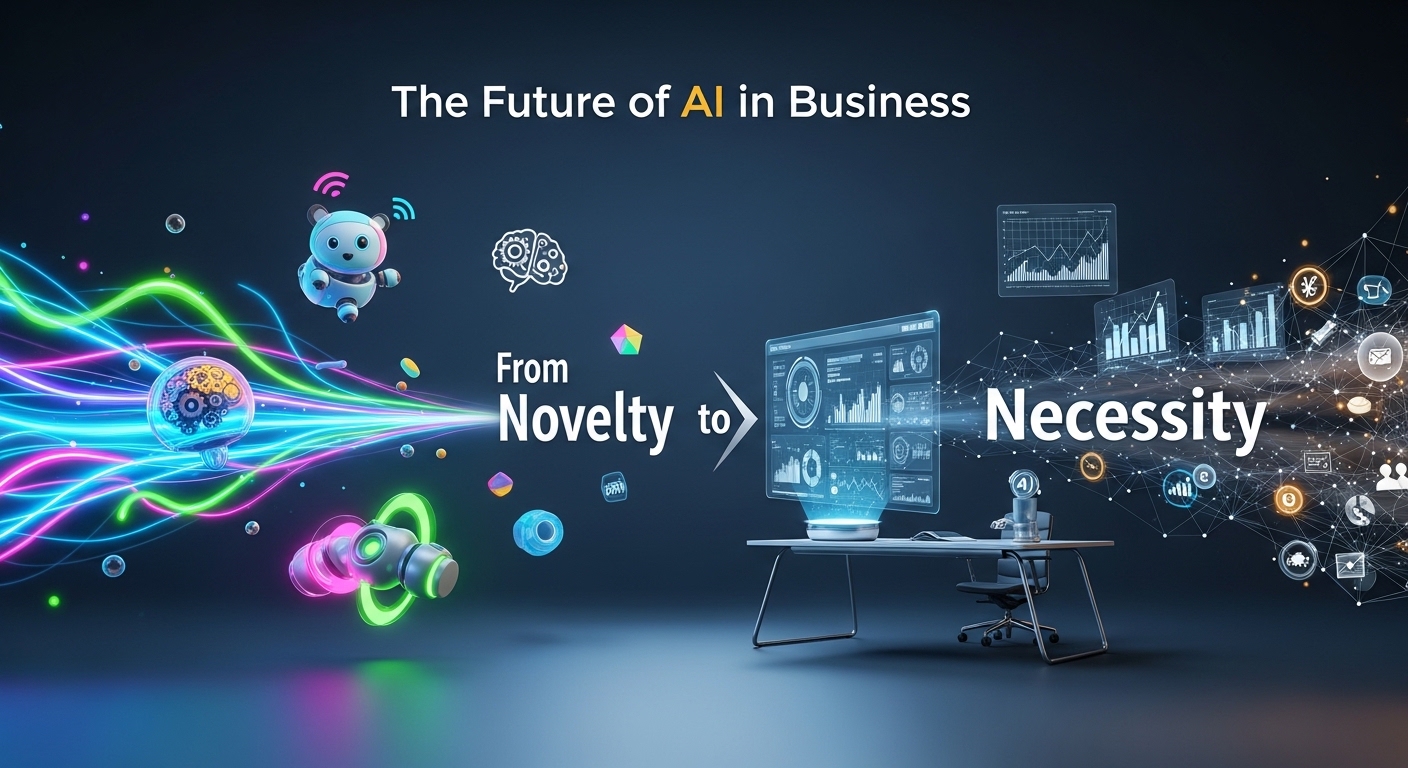
The conversation around the future of AI in business has finally shifted from “Is this real?” to “How do we not mess this up?” We are moving past the novelty stage. The glow is wearing off, and the real work is beginning.
The future of AI in business isn’t about robots replacing CEOs or sentient algorithms taking over HR. It’s far more practical, and honestly, much more interesting than that. It’s about the subtle, sometimes awkward integration of machine intelligence into the messy, human reality of commerce.
From Software That Waits to Software That Acts
For the last forty years, business software has been reactive. You click a button, and the database gives you an answer. You run a report, you interpret the data. The bottleneck has almost always been the human decision-maker.
The near future of AI flips this dynamic entirely. We are moving toward “agentic” AI systems that don’t just retrieve information but can actually execute complex workflows. Imagine a supply chain manager who doesn’t just see a dashboard showing a shipment delay. Instead, their AI assistant has already identified the delay, checked the contract with the carrier, found an alternative route, and drafted a customer notification email, waiting only for a single “Yes” from the manager.
This shifts the role of the employee from operator to validator. In my experience working with logistics firms, this transition is terrifying for managers who built their careers on being the fastest problem-solvers in the room. But the efficiency gains are undeniable. The future isn’t about AI doing the “thinking” for us; it’s about AI handling the execution of the thinking we’ve already agreed upon.
The “Centaur” Model: Hybrid Workforces

There is a lot of fear about job displacement, and to be honest, some of it is warranted. Routine, repetitive data processing tasks are on the chopping block. However, the businesses that will win in the next decade aren’t those that fire everyone and replace them with servers. They are the ones that embrace the “Centaur” model.
In chess, when a human plays alongside an AI (a Centaur), they consistently beat a human playing alone or an AI playing alone. The human provides the strategy and context; the AI provides the tactical calculations. We are seeing this already in creative fields.
Copywriters aren’t disappearing; they are becoming “prompt engineers” and high-level editors, using AI to generate twenty variations of a headline in seconds and then applying their human intuition to pick the one that actually resonates with the brand voice.
I recently spoke with a marketing director who reduced her content production timeline by 60%, not by firing her writers, but by using AI to handle the first drafts and SEO optimization. Her team now spends their time on strategy and interviews the parts of the job that actually require a soul.
Hyper-Personalization: The End of the Average Customer
If you think recommendation engines are good now, you haven’t seen anything yet. Current personalization is usually based on broad segmentation: “You bought running shoes, so you might want running socks.”
The future is granular, dynamic personalization driven by Generative AI. We are moving toward a scenario where a bank’s website doesn’t just look the same for everyone. Based on your browsing behavior, transaction history, and even the time of day, the AI will rewrite the copy and rearrange the layout of the page in real-time to suit your specific psychological profile.
This is a double-edged sword. On one hand, customer experience (CX) skyrockets. On the other hand, we enter uncanny valley territory. Businesses will have to walk a fine line between being helpful and being invasive. The companies that win will be the ones that use this power to reduce friction, not to manipulate emotions.
The Hard Truth: Data Quality is the New Currency

Here is where the rubber meets the road. Everyone wants the AI magic, but very few have their data house in order. I’ve watched startups burn through cash trying to implement cutting-edge machine learning models, only to realize their data is siloed in twenty different legacy systems, full of duplicates and errors.
An AI model is only as good as the data you feed it. If your business has bad data habits, AI will simply automate your bad decisions at scale. The immediate future for many businesses isn’t buying expensive AI tools; it’s the unsexy work of data cleaning and governance. You cannot build a skyscraper on a foundation made of sand.
Ethical Quagmires and the “Black Box”
We can’t talk about the future without addressing the risks. As we delegate more decision-making to algorithms, like who gets a loan, who gets an interview, or who gets flagged for fraud, we run into the “Black Box” problem. Often, even the developers can’t explain exactly why the AI made a specific decision.
This creates a massive liability. If your AI accidentally discriminates against a protected class in your hiring process, saying “the computer did it” won’t hold up in court. The businesses of the future will need a new breed of professionals:
I ethicists and an auditor. We are moving from “Can we build it?” to “Should we build it?” Regulatory frameworks in the EU and US are already catching up, forcing businesses to prioritize transparency over raw speed.
Democratization for Small Business
Finally, the most exciting trend is the leveling of the playing field. Previously, cutting-edge data analytics was the playground of Fortune 500 companies with million-dollar IT budgets. Today, a solopreneur with a subscription to a tool like ChatGPT or Claude can perform market research, competitor analysis, and code generation that would have required a five-person team five years ago.
I’ve seen small boutique consulting firms using AI to generate pitch decks and financial models that look better than what the Big Four accounting firms produce. This democratization allows small businesses to move faster and punch above their weight class, purely by leveraging these new cognitive tools.
The Bottom Line
The future of AI in business is not a singular event; it’s a gradual assimilation. It will be messy. There will be embarrassing public failures where chatbots curse at customers, and there will be quiet, massive victories in efficiency that we never see on the news.
To survive and thrive, don’t look at AI as a replacement for your workforce. Look at it as a new layer of intelligence, a junior associate who works 24/7, knows every document you’ve ever written, but needs a senior partner (you) to provide the judgment, ethics, and strategic vision. The technology is here. The hard part is changing the culture.
Frequently Asked Questions
Will AI completely replace human jobs in the future?
It’s unlikely to be a total replacement. While AI will automate routine and repetitive tasks (data entry, basic coding, copy generation), it will mostly shift roles toward oversight, strategy, and complex problem-solving. Jobs will evolve rather than disappear entirely.
Is AI too expensive for small businesses to implement?
Not anymore. While enterprise-grade custom solutions are costly, the barrier to entry has dropped significantly. Off-the-shelf tools like ChatGPT, Midjourney, and various CRM-integrated AI plugins are affordable and accessible to even solo entrepreneurs.
What are the biggest risks of adopting AI in business?
The primary risks are data privacy breaches, the propagation of bias in decision-making (like hiring or lending), and “hallucinations” where AI confidently presents false information. Companies need strong governance and human review processes to mitigate these risks.
How will AI change customer service?
We are moving toward predictive, 24/7 customer service. Instead of waiting on hold, customers will interact with sophisticated AI agents that can resolve complex issues instantly. Human agents will only handle escalated, sensitive, or highly nuanced problems.
Do I need to learn to code to use AI in my business?
No. The rise of “Low Code” and “No Code” platforms means you can build powerful AI workflows using natural language and visual interfaces. However, understanding basic logic and prompt engineering is becoming a valuable skill.

Related Posts