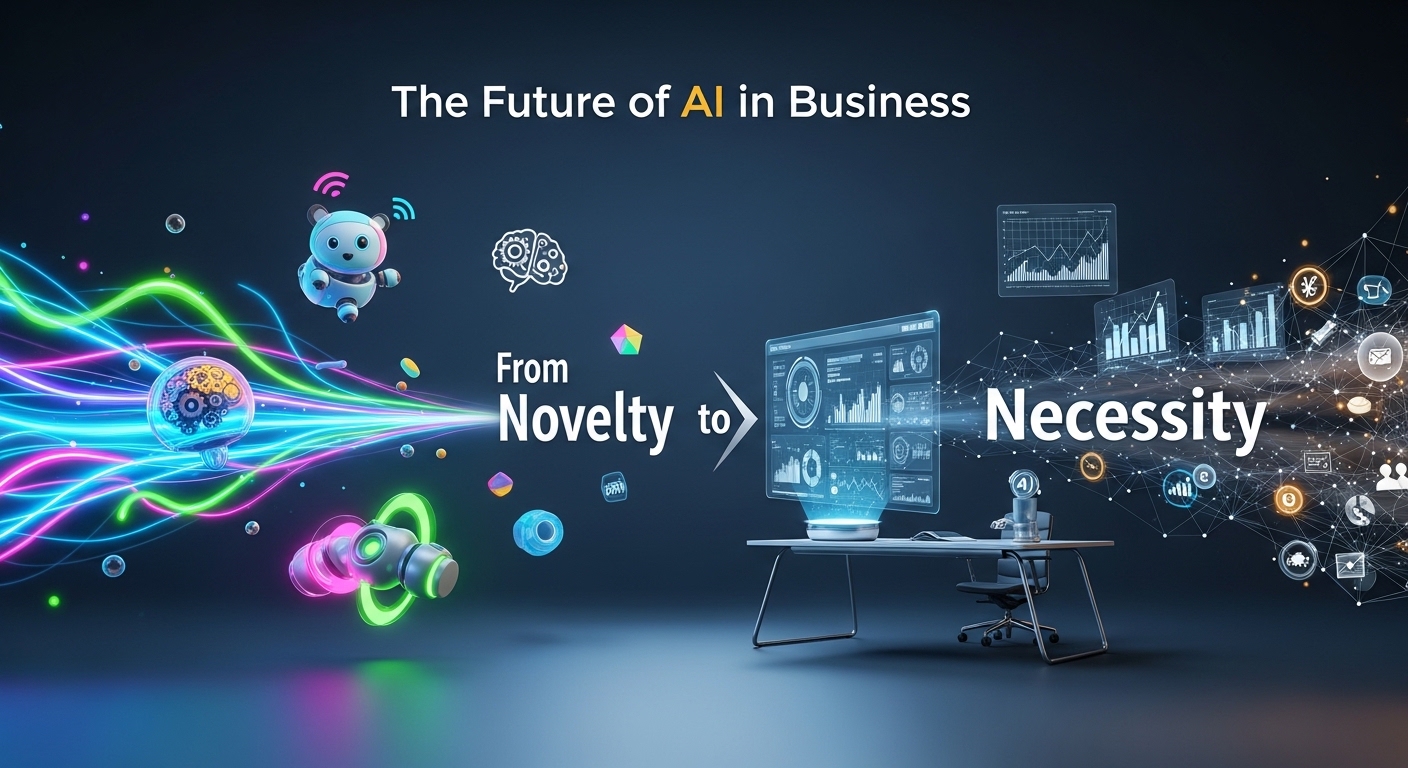
A few years ago, “AI in business” mostly meant flashy demos, experimental chatbots, and a couple of analytics projects tucked away in innovation labs. That era is ending. Over the next decade, AI won’t sit on the side as an “innovation initiative.” It will function more like the operating system of modern companies embedded in decisions, workflows, customer journeys, and even how strategies are set.
The future of AI in business isn’t about replacing humans with machines. It’s about redesigning how work gets done, what customers expect, and how companies compete. Let’s break down what that actually looks like.
1. AI Becomes Core Business Infrastructure

Right now, many organizations treat AI as a project: a chatbot here, a recommendation engine there. The next phase is AI as infrastructure, similar to cloud or the internet.
Expect to see:
- AI layers are built into every major business system
ERP, CRM, HR, finance, and supply chain tools all will ship with embedded AI “co-pilots” to summarize data, suggest actions, and automate routine tasks. - Decision engines instead of static reports
Instead of downloading spreadsheets and building slide decks, leaders will query systems in natural language:
“Show me why margins dropped in Q2 and simulate three ways to recover them without impacting customer satisfaction.” - AI governance is becoming as normal as financial controls
Policies on data use, model access, risk levels, and escalation paths will be standard. Boards will ask not just, “What’s our AI strategy?” but “How are we governing AI usage and risk across the enterprise?”
In other words, organizations that still see AI as an experiment will feel increasingly behind.
2. The Biggest Shifts AI Will Drive in Business
A. Decision-Making: From Gut-Feel to Augmented Judgment
Leaders will still make the final calls, but they’ll do it with much richer, faster insight.
- AI will continuously monitor metrics, flag anomalies, and recommend actions.
- Scenario simulation (“digital twins” of supply chains, factories, or even markets) will let leaders stress-test strategies before committing real dollars.
- Mid-level managers will rely less on manual reporting and more on conversational interfaces: “What were the top three drivers of churn last month by segment?”
The competitive edge will move from “who has more data” to who can turn data into decisions fastest without losing judgment.
B. Automation of Knowledge Work (Not Just Manual Tasks)
The first wave of automation hit factories and back-office workflows. The next wave targets knowledge work:
- Drafting contracts and summarizing legal documents
- Writing first drafts of marketing copy, sales emails, and proposals
- Preparing meeting briefs, summarizing calls, and extracting action items
- Assisting with coding, testing, and documentation
Most roles will become hybrid: part human expertise, part AI assistance. The people who thrive will be those who know how to design workflows around AI, not those who try to outrun it manually.
C. Next-Level Customer Experiences
The future customer journey will feel more personal, more conversational, and more predictive.
- 24/7 intelligent support that resolves most issues without escalation, yet knows when to hand off gracefully to a human.
- Hyper-personalized recommendations across channels, email, app, website, in-store, based not just on past purchases, but context, behavior, and even sentiment.
- Proactive service, where problems are fixed or mitigated before the customer even complains (for example, airlines rebooking before a delay hits, banks flagging unusual patterns before fraud escalates).
Done well, AI-powered CX feels less like automation and more like a brand that finally understands you.
3. How Adoption Will Actually Happen Inside Companies
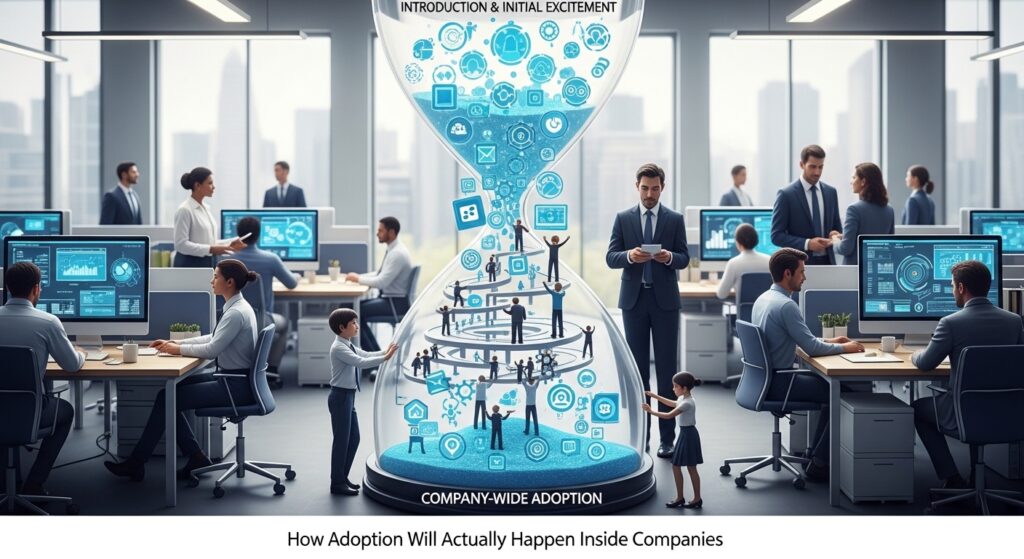
The future isn’t just about what AI can do. It’s about what organizations are realistically able to implement.
A. Data Will Make or Break AI Ambitions
Most AI dreams crash into one hard wall: data quality.
To get reliable, high-impact AI systems, companies need:
- Clean, well-governed data
- Clear ownership (who’s responsible for what dataset)
- Shared definitions (what exactly is a “customer,” a “lead,” or a “churned account”?)
The organizations that quietly invest in boring data plumbing now will be the ones running impressive AI capabilities later.
B. The Rise of AI Centers of Excellence (with a Twist)
Many enterprises are already building AI Centers of Excellence (CoEs), small, cross-functional teams that set standards, share best practices, and support business units.
The twist in the coming years: CoEs will move from building every model themselves to enabling business teams:
- Curated internal AI platforms and tools
- Guardrails, templates, and reference architectures
- Training and coaching for non-technical teams to build safe, useful AI workflows
The goal is not centralization; it’s controlled decentralization.
C. Upskilling Becomes a Core HR Strategy
In the future of AI in business, skills that matter will shift significantly:
- For leaders:
- Asking the right questions of AI
- Interpreting outputs and spotting failure modes
- Balancing efficiency vs. ethics and brand risk
- For professionals:
- Domain expertise + AI literacy (knowing where AI helps and where it fails)
- Data storytelling and communicating insights
- Workflow design around AI tools
Companies that treat training as a one-off workshop will lag. Those that bake continuous upskilling into performance, career paths, and incentives will build a real advantage.
4. Risks, Ethics, and the Trust Challenge
The future of AI in business is not all upside down. The risks are real and can be brand-defining.
Key concerns:
- Hallucinations and errors: Even advanced models can produce confident nonsense. Without proper validation steps, that can mean regulatory breaches, bad decisions, or legal exposure.
- Bias and fairness: If historical data is biased, AI can reinforce or even amplify those patterns in hiring, lending, pricing, and more.
- Privacy and security: Feeding sensitive data into AI systems without proper controls can create huge vulnerabilities.
- Regulatory pressure: Governments are moving toward tighter rules around transparency, explainability, and data handling.
Forward-thinking organizations are putting in place:
- Model validation and monitoring processes
- Clear human-in-the-loop checkpoints for critical decisions
- Transparent customer communication about where and how AI is used
- Cross-functional ethics committees or review boards
Trust will be a strategic asset in the AI era. Lose it, and everything else gets harder.
5. A Practical Roadmap for the Next 12–24 Months

For leaders wondering where to start or how to course-correct, a simple roadmap helps.
- Clarify your business problems first
Don’t start with “Which AI tools should we buy?” Start with:- Where are we losing money?
- Where are customers most frustrated?
- Where are teams drowning in repetitive work?
- Pick 3–5 high-impact, low-regret use cases
Examples:- Automating document summarization and data entry
- AI-assisted customer support
- Sales and marketing personalization
These provide quick wins and build internal confidence.
- Invest in data foundations and governance
Clean up key datasets. Decide who approves what. Put usage policies in writing. This isn’t glamorous, but it’s non-negotiable. - Build small cross-functional squads
Combine business owners, data/AI experts, IT/security, and legal/compliance. Run short, focused experiments with clear success metrics. - Measure, learn, and scale intentionally
Don’t just celebrate pilots. Track impact: time saved, revenue gained, NPS uplift, error reduction. Scale what works, retire what doesn’t.
This is less about a grand, 5‑year AI roadmap and more about iterative, disciplined progress.
6. What AI Won’t Replace
Despite the hype, AI won’t turn businesses into self-driving organisms any time soon.
Humans will remain essential for:
- Defining strategy and tradeoffs
- Navigating ambiguity, politics, and culture
- Building relationships and trust with customers, partners, and teams
- Exercising judgment in edge cases and crises
The companies that win won’t be the most automated. They’ll be the most intelligently augmentedwhere people and AI are each used for what they’re best at.
FAQs on the Future of AI in Business
1. Will AI replace most jobs in business?
AI will automate many tasks within jobs, especially repetitive or data-heavy work. Most roles will change rather than disappear, with humans focusing more on judgment, creativity, and relationship-driven work.
2. What types of business functions will see the biggest AI impact first?
Customer support, marketing, sales, finance, HR, and operations are already seeing significant AI impactthrough smarter analytics, automation, and copilots embedded into everyday tools.
3. How should small and mid-sized businesses approach AI?
Start small and practical. Use built-in AI features in tools you already pay for, focus on 1–3 clear use cases (like support or invoicing), and avoid large, custom projects until you’ve seen real returns from simpler steps.
4. What skills should business professionals build to stay relevant?
Focus on domain expertise, data literacy, basic understanding of AI capabilities and limits, critical thinking, communication, and the ability to design and manage workflows that include AI.
5. Is it safe to rely on AI for critical business decisions?
Not without human oversight. AI can surface insights and options, but critical decisions, legal, financial, strategic, should include human review, clear accountability, and validation of the underlying data and assumptions.
6. How can companies manage the ethical risks of AI?
Put in place clear policies, establish review processes for high-risk use cases, monitor models in production, train employees on responsible use, and involve legal, compliance, and ethics experts from the start, not as an afterthought.

Related Posts


