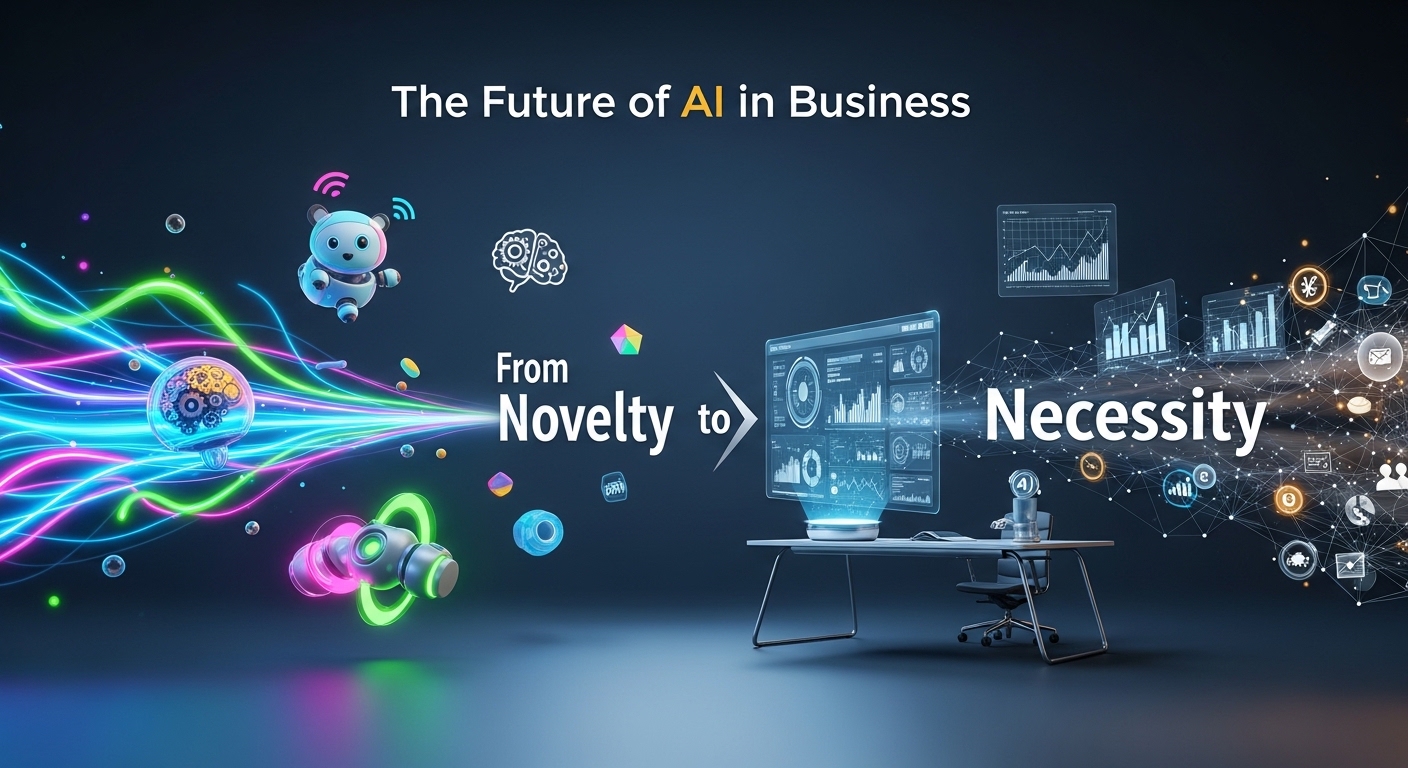

Let’s be brutally honest for a second. The term “AI for business growth” has been so hyped, so relentlessly marketed, that it’s started to sound like a mystical incantation. Sprinkle some AI on your problems, and voilà, profits appear! Having spent the last several years in the trenches, helping companies from scrappy startups to established firms navigate this shift, I can tell you the reality is far more mundane and infinitely more powerful.
AI isn’t a magic wand; it’s a fundamentally better set of tools for the age-old business tasks of understanding, deciding, and executing. Think of it like this. For decades, we’ve been building businesses with industrial-age plumbing: phone lines, filing cabinets, spreadsheets, and basic databases. They worked, but they were slow, leaky, and siloed.
Modern AI, particularly the wave of generative AI and advanced machine learning, is like replacing all that corroded piping with a smart, integrated system. It doesn’t change what water does, but it delivers it instantly, to exactly the right place, and can tell you everything about its flow. The growth comes from fixing the leaks and unlocking pressure you didn’t know you had.
The Core Shift: From Reporting to Anticipating
The single biggest mindset change I push with clients is moving from a rear-view mirror perspective to one focused on the windshield. Traditional business intelligence (BI) is fantastic at telling you what happened last quarter. AI is about figuring out what will happen next week and what you should do right now.
A concrete example from my work: a specialty retailer was drowning in inventory data. Their BI dashboard showed them which products sold out last season and which languished. Valuable, but historical. We implemented a relatively simple machine learning model that factored in not just past sales, but local weather forecasts, trending social media topics in specific zip codes, and even local event schedules.
Suddenly, they weren’t just reporting on stock-outs; they were preventing them by anticipating demand spikes for umbrellas in one district and BBQ supplies in another before the weekend hit. Their growth came from a 20% reduction in lost sales from stock-outs and a 15% decrease in overstock waste. That’s not magic; it’s just better, more connected plumbing.
Where the Rubber Meets the Road: Practical Starting Points

You don’t need a team of PhDs to start. In fact, the most successful implementations I’ve seen begin with a focused, painful problem. Here’s where to look:
- Customer Operations: The 80/20 Rule on Steroids. Support is a universal cost center. AI-powered chatbots have evolved from frustrating loops to capable first-line resolvers for common issues. But the real gold is in the back-end. Tools that analyze support ticket sentiment, cluster emerging issues before they become avalanches, and auto-suggest solutions to agents slash handle times and boost satisfaction. One B2B software client used this to cut their tier-1 support volume by 40%, freeing their human team to handle complex, high-value client relationships that actually drove expansions.
- Content & Marketing: Scale Your Voice, Not Just Your Output. Everyone jumps to “AI writing,” which is a recipe for generic slop. The smarter approach? Use AI as a force multiplier for your best human creatives. I advise teams to use it for research synthesis (feed it competitor analyses and customer interviews to find gaps), generating first drafts of routine content (product descriptions, meta tags), and, most powerfully, personalizing at scale. An email campaign can dynamically adjust its tone, highlights, and even offers based on a lead’s industry, job title, and past engagement. It feels human because it’s guided by a human strategy.
- Internal Knowledge: Taming the Silo Beast. In companies larger than about 50 people, institutional knowledge goes to die in SharePoint folders, Slack archives, and disconnected databases. Deploying an internal, secure AI search assistant, a kind of “Google for everything we know,” has been a game-changer for productivity. New sales hires can instantly find case studies for a specific industry. Engineers can find design notes from three years ago. The growth impact is in accelerated onboarding, reduced duplicate work, and faster decision-making.
The Human in the Loop: This is Non-Negotiable

This is where experience screams the loudest: AI does not run itself. The “human-in-the-loop” model is critical. You need people to train the models, interpret their outputs, catch biases, and make the final ethical calls. I once audited a recruiting tool that was perfectly “optimizing” for hires who stayed longest. The AI had quietly learned to deprioritize applicants from women’s colleges.
As data from that male-dominated industry showed (for regrettable cultural reasons), women had a higher attrition rate. The AI found a pattern and perpetuated it. Without a human expert to ask, “Why is it making this choice?” the damage would have been profound. Our strategy must budget for this ongoing oversight. It’s not just a technical cost; it’s an ethical and operational imperative.
The Long Game: From Projects to Platform
Starting with a point solution is wise. But sustainable growth comes from evolving your AI from isolated projects into a core business platform. This means investing in clean, accessible data architecture, the pipes themselves.
It means building a culture where teams are encouraged to experiment with these tools to solve their own problems. The goal is to reach a point where AI is simply how work gets done, invisible and indispensable, driving a continuous cycle of optimization and uncovering new opportunities that were previously invisible in the data fog.
The businesses that will win aren’t the ones with the most AI. They’re the ones that use AI to be the most human to understand their customers more deeply, empower their employees more fully, and make smarter, faster decisions. That’s the real growth engine. Stop looking for a magic spell, and start upgrading your plumbing.
FAQs
Q: How much does it cost to get started with AI for my business?
A: It varies wildly. You can pilot a specific tool (like a customer service bot or a marketing personalization plugin) for a few hundred dollars a month. Building custom solutions starts in the tens of thousands. The highest cost is often internal: the time to manage, train, and integrate.
Q: Do I need to hire data scientists?
A: Not necessarily for initial steps. Many off-the-shelf SaaS tools are designed for non-technical users. As you scale into custom work, you’ll need that expertise, either in-house or through a trusted partner.
Q: Isn’t there a big risk of AI making mistakes?
A: Absolutely. All AI systems have an error rate. This is why the “human-in-the-loop” principle is vital. Use AI for augmentation and suggestion, not fully autonomous, irreversible decisions, especially in sensitive areas like hiring or finance.
Q: How do I measure the ROI of an AI project?
A: Tie it directly to a key business metric before you start. For a support bot, measure reduction in average handle time or ticket volume. For a sales tool, measure lead conversion rate or upsell value. Start with a pilot and A/B test if possible.
Q: Is my data too messy or small to use AI?
A: Possibly, but this is often the first project: cleaning and centralizing data. Even modest amounts of clean, relevant data can power useful models. The process of preparing for AI often delivers valuable business insights on its own.

Related Posts