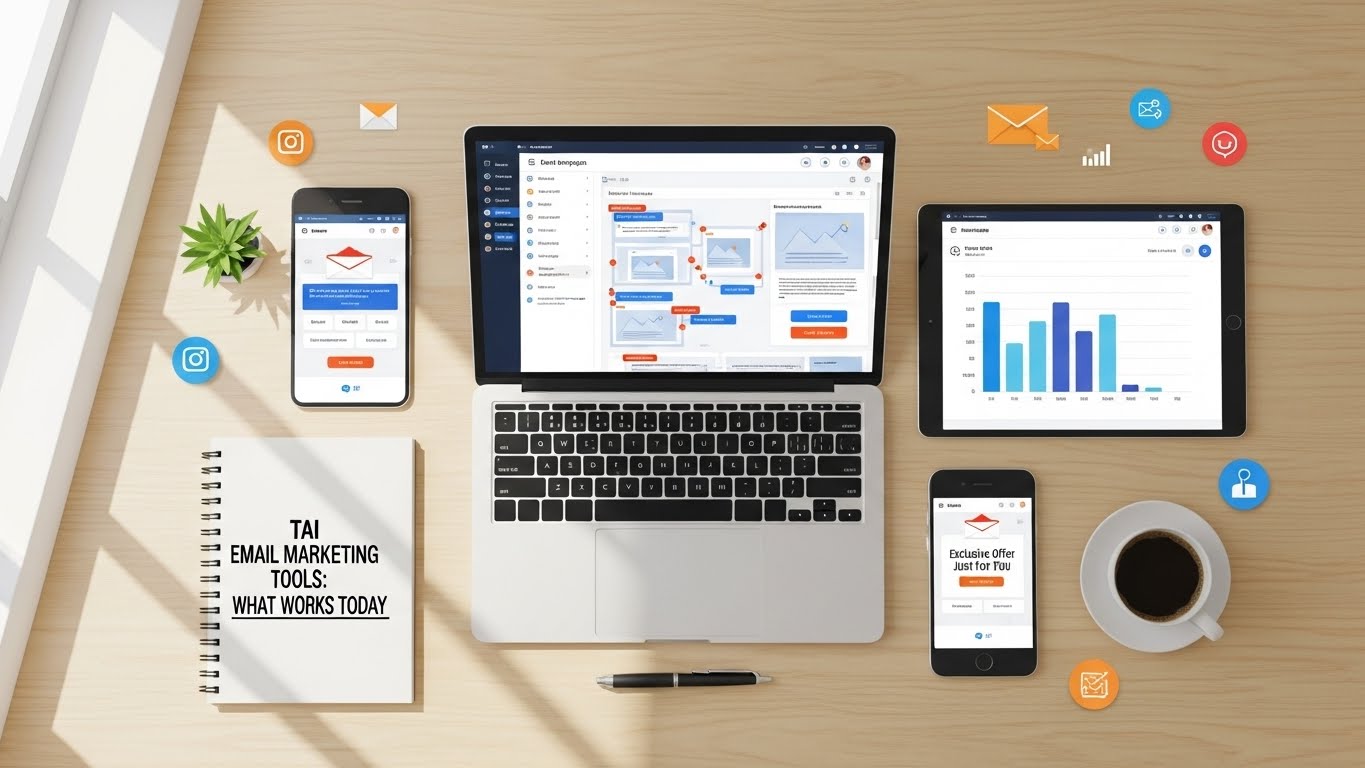
I’ll be straight with you, email marketing isn’t what it used to be. Five years ago, you could blast a newsletter with a catchy subject line and watch the conversions roll in. Today? Your audience is drowning in messages, and attention spans have shrunk to nothing. This is where AI email marketing tools have genuinely changed the game, though not always in the ways vendors promise.
After spending the better part of three years testing these platforms for various clients and my own projects, I’ve learned that AI in email marketing is less about magic robots writing perfect copy and more about handling the grunt work that used to eat up entire afternoons. Let me walk you through what’s actually useful, what’s overhyped, and how to think about these tools if you’re considering adding them to your stack.
The Real Value Proposition
The most transformative aspect of AI email tools isn’t the flashy stuff marketers love to showcase. It’s the segmentation and send-time optimization happening behind the scenes. Traditional email platforms let you segment by basic demographics, age, location, and maybe purchase history. AI-powered systems can analyze hundreds of behavioral signals simultaneously.
I worked with an e-commerce client who was manually segmenting their list into about eight groups. We switched to an AI tool that identified 47 distinct behavioral patterns, from browsing habits to email engagement timing. Revenue from email jumped 34% in two months, not because we wrote better subject lines, but because people started receiving relevant messages when they were actually checking their inbox.
The tool tracked when individual subscribers typically opened emails (down to the hour), what devices they used, which product categories they lingered on, and even how their engagement changed seasonally. This level of personalization simply isn’t feasible manually unless you have a team of analysts with nothing better to do.
Subject Line Generation: Useful, Not Revolutionary

Let’s talk about AI copywriting features, since that’s what gets the most attention. Most AI email tools now offer subject line suggestions, body copy assistance, and even full email drafts. Here’s my honest take: they’re helpful starting points, nothing more. I’ve used AI to generate subject line variations countless times.
It’s excellent for breaking writer’s block and suggesting angles I hadn’t considered. But I’ve never used an AI-generated subject line without editing it. The suggestions often lack brand voice and tend toward the generic. “Unlock exclusive savings” and “You won’t believe this deal” appear with numbing frequency.
Where AI shines is A/B testing at scale. Some platforms can automatically generate and test dozens of subject line variations, learning what resonates with your specific audience. This beats the traditional approach of testing two options and calling it a day. One tool I use regularly runs multi-armed bandit tests, continuously adjusting which subject lines get sent based on real-time performance.
Predictive Analytics: The Unsexy Powerhouse
The least sexy feature is often the most valuable. Predictive lead scoring and churn prediction have saved my clients more money than any clever subject line ever could. These features analyze subscriber behavior to predict who’s likely to convert, who’s drifting toward disengagement, and who’s about to unsubscribe.
A SaaS company I consulted for used this to identify trial users showing early churn signals, things like declining login frequency, ignored onboarding emails, and feature usage patterns. By triggering personalized intervention campaigns, they reduced trial-to-paid drop-off by 28%.
The system flagged at-risk users I would have completely missed. One pattern it identified: users who opened every email in the first week but didn’t click any links were 73% likely to churn within two weeks. Armed with that insight, we created a specific campaign for that micro-segment addressing common technical roadblocks. Simple fix, measurable impact.
Content Recommendations and Dynamic Emails:

Dynamic content has existed for years, but AI makes it actually practical. Instead of creating rules manually (“if customer bought shoes, show shoe care products”), modern tools analyze patterns across your entire customer base to predict what each person wants to see.
A media company I worked with uses AI to populate its newsletter with personalized article recommendations for each subscriber. Not just “you clicked on politics articles, here are more politics articles,” but nuanced predictions considering reading time, topic combinations, author preferences, and how those preferences shift over time.
The open rates stayed roughly the same, but click-through rates nearly doubled because people were seeing content they actually cared about. The newsletter stopped being a generic broadcast and started feeling like a curated selection.
The Limitations Nobody Mentions:
Here’s what the sales demos won’t tell you: these tools require clean data and meaningful volume to work properly. If you have 500 subscribers and inconsistent engagement tracking, AI can’t work miracles. You need thousands of data points before patterns become reliable.
I’ve also seen companies over-rely on AI recommendations without understanding the underlying logic. One client let an AI tool completely control send times and wondered why their B2B newsletter went out at 2 AM.
Turned out their data was corrupted by bot traffic, and the system was optimized for non-human engagement patterns. AI tools also struggle with major strategy pivots. If you’re repositioning your brand or entering a new market, historical data becomes less relevant. You’ll need human judgment to guide the transition period.
Privacy and Ethics Considerations
We need to talk about the creepiness factor. AI enables personalization that can cross from “helpful” to “invasive” quickly. Just because you can detect that someone reads your emails at 11 PM while apparently shopping for baby products doesn’t mean every use of that information feels appropriate. I’m cautious about over-personalization. There’s a sweet spot between generic and unsettling.
One retailer I advised wanted to reference specific browsing sessions in email copy (“We noticed you looked at red sneakers for 14 minutes”). I pushed back. It’s accurate, but it makes people feel surveilled. The best approach treats AI insights as guidelines for relevance, not ammunition for psychological manipulation. Use the data to be more helpful, not more intrusive.
Choosing the Right Tool:
The market is crowded with options. Mailchimp has AI features, dedicated platforms like Phrasee and Persado focus on copy optimization, and enterprise solutions like Salesforce Marketing Cloud embed AI throughout. Start by identifying your actual bottleneck. Struggling with segmentation? Look for strong predictive analytics.
Need help with creative? Focus on copywriting assistance. Don’t buy the most feature-rich platform if you’ll only use 10% of it. Most importantly, maintain realistic expectations. These tools amplify good strategy; they don’t replace it. If your fundamental offer isn’t compelling or your list is disengaged, AI won’t fix that.
FAQs
Do I need technical expertise to use AI email marketing tools?
No, most modern platforms are designed for marketers, not data scientists. The AI runs in the background while you use familiar interfaces.
How much data do I need before AI features become effective?
Generally, at least 1,000 active subscribers and several months of engagement history. Smaller lists can use AI, but predictions will be less reliable.
Will AI replace email copywriters?
Not remotely. AI assists with ideation and testing, but lacks the strategic thinking and brand understanding humans provide.
Are AI email tools expensive?
Pricing varies widely. Entry-level features appear in standard Mailchimp plans, while enterprise solutions can cost thousands monthly. ROI typically justifies costs for engaged lists over 5,000 subscribers.
How do I know if the AI recommendations are working?
Compare performance metrics before and after implementation. Focus on engagement rates, conversion rates, and revenue per email rather than just open rates.

Related Posts