
The phrase “AI-powered software solutions” has become ubiquitous, tossed around in boardrooms and tech blogs alike. But beyond the buzzwords and the occasional over-hyped headlines, what does it truly mean to leverage artificial intelligence within our everyday software, and what practical impact is it having right now?
From my vantage point, having watched, studied, and even had a hand in deploying these technologies across various sectors, it’s clear. We’re not just talking about incremental improvements anymore. We’re witnessing a fundamental shift in how software behaves, moving from being a static tool to a dynamic, learning, and often anticipatory partner. This isn’t science fiction; it’s the current state of play for businesses savvy enough to harness its power.
What Makes Software “AI-Powered”? It’s All About Learning
At its core, traditional software follows explicit instructions. You tell it to do X, it does X. If you want it to do Y, you have to code Y. AI-powered software, on the other hand, learns. It identifies patterns, makes predictions, and even generates new content or solutions based on data, without being explicitly programmed for every single scenario. This capability stems primarily from machine learning (ML) – a subset of AI that involves algorithms trained on vast datasets.
Whether it’s deep learning, which powers incredibly complex pattern recognition tasks like facial identification, or natural language processing (NLP) that allows computers to understand and generate human language, these technologies imbue software with a form of intelligence. We’re talking about systems that can interpret, analyze, and even adapt their functionality over time, continually improving their performance as they encounter more data.
The Unmistakable Impact: Why AI Matters to Your Business
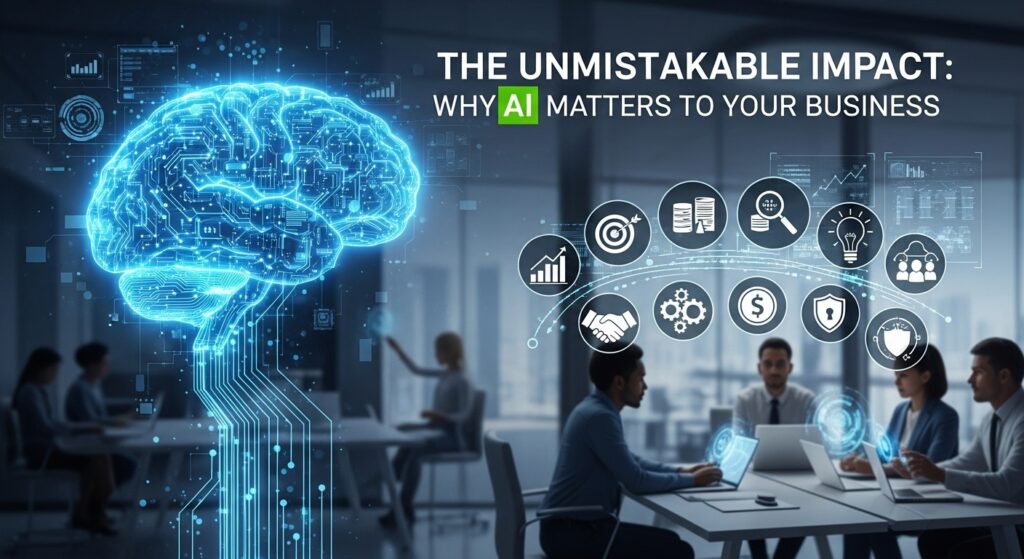
The shift from static to intelligent software isn’t merely academic; it translates into tangible business advantages. I’ve seen firsthand how these AI software solutions are reshaping operations, customer engagement, and strategic decision-making.
- Automation Beyond Repetition: We’ve long automated repetitive tasks with Robotic Process Automation (RPA), but AI takes this a step further. Intelligent automation, often leveraging computer vision and NLP, can automate complex, knowledge-based tasks that previously required human judgment. Think of an AI sorting incoming customer emails by sentiment and urgency, then routing them to the correct department – a task that’s far more nuanced than simply moving files from Folder A to Folder B.
- Enhanced Decision-Making with Predictive Analytics: Data has always been valuable, but AI turns it into a crystal ball. Predictive analytics, driven by sophisticated machine learning models, can forecast trends, identify potential risks, and recommend optimal actions. In finance, this means detecting fraudulent transactions in real-time. In manufacturing, it’s predicting equipment failures before they happen, moving from reactive maintenance to proactive planning. The ability to make data-driven decisions at speed is a game-changer.
- Hyper-Personalization and Customer Experience: From Netflix recommendations to personalized product suggestions on e-commerce sites, AI is at the heart of tailored experiences. By analyzing customer behavior, preferences, and interactions, AI-powered marketing and customer service tools can deliver highly relevant content, offers, and support. This fosters stronger customer loyalty and significantly boosts engagement, creating an experience that feels less like a transaction and more like a conversation.
- Unlocking New Capabilities and Innovation: Some of the most exciting applications of AI-powered software solutions lie in areas previously thought impossible. In drug discovery, AI can rapidly analyze molecular structures and predict potential drug candidates, drastically shortening research cycles. In design, generative AI can produce countless iterations of a product or architectural plan, helping engineers and designers explore possibilities far beyond human capacity. It’s opening doors to innovation we couldn’t have imagined a decade ago.
Real-World Scenarios: AI in Action
Let’s ground this in a few concrete examples I’ve observed:
- Healthcare Diagnostics: Consider radiology. AI algorithms, trained on millions of medical images, are now assisting radiologists in identifying anomalies in X-rays, CT scans, and MRIs with remarkable accuracy, often flagging subtle indicators that a human eye might miss, improving early diagnosis and treatment outcomes.
- Financial Fraud Detection: Banks deploy sophisticated machine learning solutions that analyze millions of transactions per second. These systems don’t just look for known fraudulent patterns; they learn to identify new, evolving schemes, protecting both the institution and its customers from significant losses.
- Supply Chain Optimization: Businesses use AI to predict demand fluctuations, optimize logistics routes, and manage inventory more efficiently. This isn’t just about saving money; it’s about building resilient supply chains that can react to unforeseen disruptions, as we’ve seen become critically important in recent years.
The Road Ahead: Challenges and Ethical Considerations

While the benefits are profound, it would be disingenuous to ignore the complexities. Deploying enterprise AI isn’t without its hurdles. Firstly, data quality is paramount. “Garbage in, garbage out” has never been truer.
Biased, incomplete, or inaccurate data will lead to flawed AI models, potentially perpetuating inequities or leading to incorrect decisions. This is a critical ethical consideration, demanding careful data curation and fairness testing.
Secondly, the “black box” problem persists for some advanced models. Understanding why an AI made a particular decision can be challenging, hindering transparency and trust, especially in critical applications like healthcare or legal judgments. We need ongoing research and development into explainable AI (XAI) to build more transparent and accountable systems.
Finally, while AI innovation creates new jobs and enhances existing ones, concerns about job displacement are valid. The focus must be on reskilling and upskilling the workforce, ensuring that humans can collaborate effectively with AI, focusing on tasks that require creativity, empathy, and complex problem-solving.
Embracing the Future with Intelligent Software
For businesses looking to integrate AI-powered software solutions, my advice is always to start with a clear problem, not just a desire for “more AI.” What pain points can intelligent automation alleviate? What insights are currently hidden in your data? What customer experiences could be transformed?
The landscape of artificial intelligence software is evolving rapidly. From increasingly sophisticated natural language processing to ubiquitous computer vision applications, the future of software is undeniably intelligent.
It’s about augmenting human capabilities, not replacing them; about making our digital tools smarter, more responsive, and ultimately, more valuable. The companies that embrace this transformation, with a keen eye on both the potential and the pitfalls, are the ones that will truly thrive in this new era.
FAQs about AI-Powered Software Solutions
Q1: What exactly is an AI-powered software solution?
A1: It’s software that uses artificial intelligence, primarily machine learning, to learn from data, make predictions, automate complex tasks, and adapt its behavior over time, rather than relying solely on explicit programming.
Q2: How does AI software differ from traditional software?
A2: Traditional software executes pre-defined rules; AI software can learn, reason, and adapt based on data, allowing it to perform tasks that require human-like intelligence, such as recognizing patterns or understanding language.
Q3: What are the main benefits of using AI-powered software?
A3: Key benefits include increased automation and efficiency, enhanced decision-making through predictive analytics, personalized customer experiences, and the ability to unlock new innovative capabilities and insights.
Q4: Is AI-powered software only for large corporations?
A4: No. While large enterprises are significant adopters, many accessible and scalable AI tools are available for small and medium-sized businesses, especially in areas like customer service (chatbots), marketing analytics, and operational efficiency.
Q5: What are the biggest challenges in implementing AI software?
A5: Major challenges include ensuring high-quality, unbiased data, addressing the black box problem (understanding how AI makes decisions), managing implementation costs, and navigating ethical considerations around privacy and job displacement.

Related Posts