

A few years ago, AI was the shiny new toy every startup slapped “AI-powered” on their pitch deck, investors threw money at anything with a neural network, and consultants promised revolution overnight. Fast forward to 2026, and the landscape has shifted. The hype has settled, the failures have been documented, and the real, profitable AI business opportunities are emerging not in moonshot projects, but in practical, scalable applications that solve actual problems.
I’ve spent the last decade working with businesses from scrappy startups to Fortune 500s, helping them separate AI fantasy from reality. What’s clear now is that the biggest opportunities aren’t in building the next ChatGPT. They’re applying AI to existing workflows, automating the invisible friction in industries, and creating tools that make people’s jobs easier, not obsolete.
Here’s where the real money is being made in AI today, based on real case studies, market trends, and the lessons learned from failed experiments.
1. The AI Gold Rush Isn’t in Building Models, It’s in the Picks and Shovels
During the California Gold Rush, the people who got rich weren’t the miners; they were the ones selling picks, shovels, and Levi’s jeans. The same is true in AI.
The mistake: Many entrepreneurs still think the path to success is training a better large language model (LLM) or fine-tuning an open-source alternative. Unless you’re backed by billions (like Mistral or Anthropic), you’re fighting a losing battle against giants like Google, Microsoft, and Meta.
The opportunity: The real demand is in tools that make AI usable for non-technical businesses.
Think:
- No-code AI platforms (e.g., tools that let marketers generate ad copy without prompt engineering)
- AI middleware (solutions that connect LLMs to legacy enterprise systems)
- Specialized fine-tuning services (helping companies adapt general AI to niche industries like legal, healthcare, or manufacturing)
Example: A client in the insurance industry was struggling with claims processing thousands of documents, manual data entry, and high error rates. Instead of building a custom AI from scratch, we integrated a document understanding API (like those from AWS Textract or Adobe’s AI tools) with their existing system. Result? 40% faster processing, 20% cost reduction, and zero need for an in-house AI team.
Key takeaway: You don’t need to invent the AI; you need to package it, simplify it, and sell it to the people who can’t (or won’t) build it themselves.
2. The “Boring” Industries Are Where AI Is Making Bank

Tech bro culture loves to talk about AI in Silicon Valley, but the real adoption is happening in industries that don’t make headlines:
- Logistics & Supply Chain (predictive maintenance, route optimization)
- Healthcare (automated medical coding, patient triage chatbots)
- Legal & Compliance (contract analysis, regulatory change tracking)
- Manufacturing (defect detection via computer vision)
- Agriculture (crop monitoring with drone + AI analytics)
Why? These industries have high operational costs, repetitive tasks, and clear ROI metrics perfect for AI automation.
Case Study: A mid-sized law firm was spending $500K/year on junior associates reviewing NDAs and contracts. We implemented a contract analysis tool (not a custom AI, just a well-configured commercial solution) that flagged risky clauses and extracted key terms. Within six months, they reduced contract review time by 60% and reallocated junior lawyers to higher-value work.
The catch: These industries move slowly. You need deep domain expertise (or a partner who has it) to sell effectively. A generic “AI for business” pitch won’t work; you need to speak their language.
3. The Rise of “AI as a Feature” (Not a Product)
The most successful AI businesses in 2026 aren’t selling AI; they’re enhancing existing products with AI.
Examples:
- Canva (AI-powered design suggestions)
- Zoom (real-time meeting summaries)
- Shopify (AI product descriptions)
- Notion (AI-assisted note-taking)
Why this works:
- Lower customer acquisition cost (you’re selling to an existing user base)
- Higher retention (AI makes the product stickier)
- Easier to monetize (upsell AI features as premium add-ons)
How to apply this:
If you’re building a SaaS product, ask: “Where in our workflow can AI save users 10 minutes a day?” Even small time savings add up to big productivity gains, and customers will pay for that.
Example: A project management tool we worked with added an AI meeting note-taker that auto-generated action items. Usage of their premium plan increased by 25% because teams saw immediate value.
4. The Hidden Market: AI for Small Businesses (Not Just Enterprises)
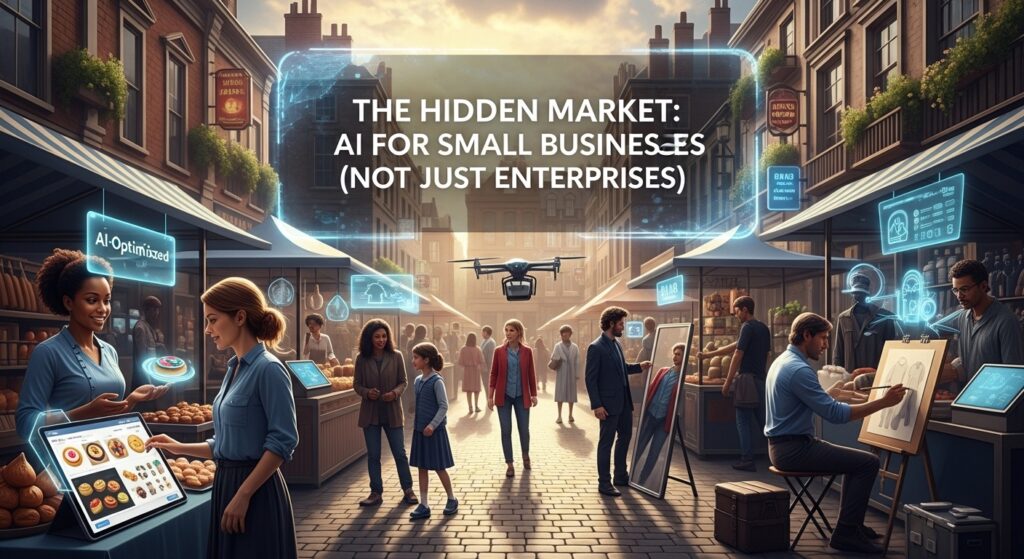
Most AI vendors focus on enterprises because they have big budgets. But small businesses (SMBs) are a massive, underserved market.
The problem: SMBs don’t have IT teams or data scientists. They need plug-and-play AI that works out of the box.
Opportunities:
- AI-powered CRM assistants (e.g., auto-follow-ups, lead scoring)
- Localized marketing tools (e.g., AI-generated social media posts for restaurants)
- Automated bookkeeping (e.g., receipt scanning + expense categorization)
Case Study: A digital marketing agency for dentists used AI-generated ad copy to cut their creative time in half. They didn’t need a custom model, just a well-trained template system that understood dental marketing lingo.
Key insight: SMBs won’t pay for “AI,” they’ll pay for results. Frame your product in terms of time saved, revenue gained, or mistakes avoided.
5. The Ethical (and Profitable) Side: AI for Compliance & Risk Management
With GDPR, CCPA, and emerging AI regulations, businesses are scrambling to stay compliant. This creates a huge opportunity for AI-powered governance tools.
Examples:
- Automated data privacy audits (scanning databases for PII leaks)
- AI bias detection (for HR hiring tools)
- Regulatory change trackers (alerting companies when laws affecting their industry update)
Why this is lucrative:
- Recurring revenue (compliance is ongoing)
- High switching costs (once a company trusts your tool, they won’t leave)
- Government & enterprise contracts (big budgets, long-term deals)
Example: A fintech startup we advised built an AI-powered AML (anti-money laundering) tool that flagged suspicious transactions with 30% fewer false positives than traditional systems. Banks paid 3x more for the accuracy improvement.
6. The Next Frontier: AI + Human Hybrid Workflows
The biggest misconception about AI is that it replaces humans. The real opportunity is in augmenting human work, not eliminating it.
Examples:
- AI drafts, humans refine (e.g., legal briefs, marketing copy)
- AI flags issues, humans decide (e.g., fraud detection, medical diagnostics)
- AI handles repetitive tasks, and humans focus on strategy
Case Study: A content agency used AI to generate first drafts of blog posts, which human editors then refined. This doubled their output without hiring more writers.
Key takeaway: The best AI businesses don’t sell replacement, they sell superpowers.
7. The Risks No One Talks About (And How to Avoid Them)
Not every AI business succeeds. Here’s why most fail and how to dodge the pitfalls:
| Risk | Why It Happens | How to Avoid It |
|---|---|---|
| Over-engineering | Building a custom AI when an off-the-shelf solution would work | Start with existing APIs (e.g., OpenAI, AWS, Google Vertex) before reinventing the wheel |
| Ignoring data quality | Garbage in, garbage out bad training data = useless AI | Spend 50% of your budget on clean, labeled data |
| No clear ROI | Garbage in, garbage out, bad training data = useless AI | Sell specific outcomes (e.g., “reduce customer support costs by 30%”) |
| Regulatory blind spots | AI in healthcare, finance, or legal? Compliance is non-negotiable | Partner with legal experts early |
| Underestimating adoption friction | If users don’t trust or understand the AI, they won’t use it | Design for transparency (e.g., “Here’s why the AI recommended this”) |
How to Get Started (Without Millions in Funding)

You don’t need to be a tech giant to capitalize on AI. Here’s a realistic roadmap:
- Pick a niche (e.g., “AI for dental clinics” vs. “AI for everyone”).
- Validate demand (talk to 50 potential customers before writing code).
- Start with existing tools (use APIs like OpenAI, Anthropic, or Hugging Face).
- Focus on integration (your AI should plug into tools people already use).
- Adoption price (freemium or low-cost entry to prove value, then upsell).
- Sell outcomes, not tech (e.g., “Get 5 more appointments per week” vs. “We use GPT-4”).
FAQs: AI Business Opportunities in 2026
Q: Do I need a technical background to start an AI business?
No, but you need either:
- A technical co-founder, or
- A deep understanding of how to apply AI to a specific industry (e.g., real estate, healthcare).
Many successful AI businesses are built by non-technical founders who partner with engineers or use no-code tools.
Q: What’s the fastest way to monetize AI?
B2B SaaS with AI features (e.g., adding AI to an existing product) or niche automation tools (e.g., AI for invoice processing in accounting firms).
Avoid: consumer AI unless you have a viral growth strategy—B2B has clearer revenue paths.
Q: How much does it cost to build an AI product?
- MVP (using existing APIs): $5K–$50K
- Custom fine-tuned model: $100K–$500K+
- Enterprise-grade AI system: $1M+
Pro tip: Start with off-the-shelf AI (e.g., OpenAI’s API) before investing in custom development.
Q: Which industries are most resistant to AI adoption?
- Highly regulated fields (e.g., pharmaceuticals, aerospace) due to compliance risks.
- Unionized labor sectors (e.g., some manufacturing) are politically sensitive.
- Creative industries (e.g., film, music) are where AI is seen as a threat to jobs.
Workaround: Focus on augmentation, not replacement (e.g., AI-assisted editing for filmmakers).
Q: Will AI opportunities dry up in a few years?
No, but the low-hanging fruit will disappear. The next wave will be in:
- AI + robotics (physical automation)
- AI for scientific discovery (e.g., drug development)
- Hyper-personalized AI (e.g., 1:1 tutoring, mental health coaches)
Q: How do I stay ahead of AI trends?
- Follow arXiv (for research papers) and TechCrunch/VentureBeat (for commercial applications).
- Join industry-specific AI communities (e.g., AI in Healthcare on LinkedIn).
- Talk to customers’ real pain points > theoretical trends.
Final Thought: The AI Revolution Is Just Getting Started
The businesses that will thrive in AI aren’t the ones chasing the next viral model; they’re the ones solving real problems with practical, scalable solutions. Whether you’re building AI-powered tools for plumbers, automating back-office tasks for law firms, or helping e-commerce stores personalize at scale, the key is the same.

Related Posts