
A few years ago, I sat in a boardroom with a Fortune 500 executive who had just greenlit a seven-figure AI transformation project. His team had promised him a 30% efficiency boost, predictive analytics that would “eliminate guesswork,” and a customer experience so personalized it would feel like magic. Fast forward 18 months, and the project was hemorrhaging money over budget, underperforming, and, worst of all, creating more problems than it solved.
This isn’t an isolated case. Across industries, businesses are rushing to adopt AI-driven strategies, seduced by the promise of automation, hyper-personalization, and data-driven decision-making. But beneath the hype lies a harsh reality: AI isn’t a silver bullet. It’s a tool that can either supercharge your business or sink it, depending on how you use it.
In this article, I’ll break down the real-world implications of AI-driven business strategy, what works, what doesn’t, and the hidden pitfalls most consultants won’t tell you. Drawing from my own experience advising companies on digital transformation, as well as case studies from early adopters, I’ll cover:
- The three biggest misconceptions about AI in business
- Where AI actually delivers value (and where it fails)
- The human factor: Why AI can’t replace judgment (yet)
- Ethical and operational risks you’re probably ignoring
- A practical framework for integrating AI without self-destructing
By the end, you’ll have a clear-eyed view of what AI can and can’t do for your business.
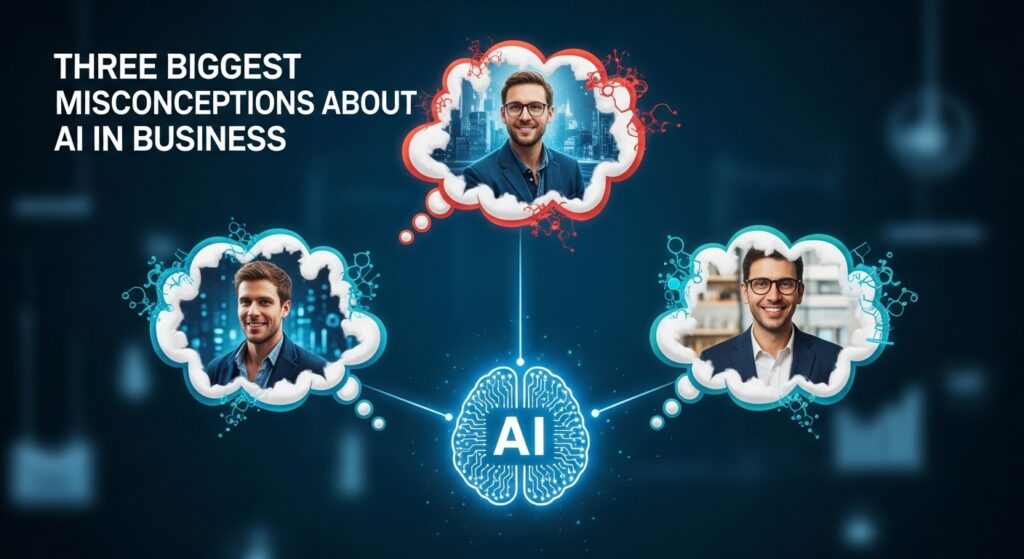
The Three Biggest Misconceptions About AI in Business
1. “AI Will Replace Human Workers Overnight.”
The fear of AI-driven job displacement is real, but the timeline is often exaggerated. Yes, AI can automate repetitive tasks, data entry, basic customer service, and even some legal research, but it struggles with nuance, creativity, and emotional intelligence.
Example: A major bank I worked with implemented an AI-powered loan approval system, expecting to cut underwriting staff by 40%. Instead, they found that the AI flagged too many false positives (rejecting qualified applicants) and false negatives (approving risky loans). The result? They had to hire more human reviewers to double-check the AI’s work.
Reality: AI augments human work, but it rarely replaces it entirely, at least not yet. The most successful companies use AI to handle the boring parts of a job, freeing employees to focus on higher-value tasks.
2. “More Data = Better AI”
Big data was the buzzword of the 2010s, and now AI is the next shiny object. But here’s the truth: Most companies don’t need more data; they need better data.
Case Study: A retail client spent millions building a massive customer database, only to discover that 60% of the data was either duplicate, outdated, or irrelevant. Their AI recommendation engine, trained on this messy data, kept suggesting winter coats to customers in Florida. The fix? They spent more money cleaning the data than they did on the AI itself.
Reality: AI is only as good as the data it’s trained on. Garbage in, garbage out. Before investing in AI, audit your data, clean it, structure it, and ensure it’s actually useful.
3. “AI Is a One-Time Investment.t”
Many executives treat AI like a software purchase: “We’ll buy it, implement it, and it’ll work forever.” Wrong.
Example: A logistics company deployed an AI-powered route optimization system, saving 15% on fuel costs in the first year. But as traffic patterns, fuel prices, and delivery demands changed, the AI’s recommendations became outdated. Without continuous updates and retraining, the system started suggesting inefficient routes, costing the company more than it saved.
Reality: AI is not a “set it and forget it” solution. It requires ongoing maintenance, retraining, and human oversight. If you’re not prepared for that, you’re better off sticking with traditional methods.
Where AI Actually Delivers Value (And Where It Fails)
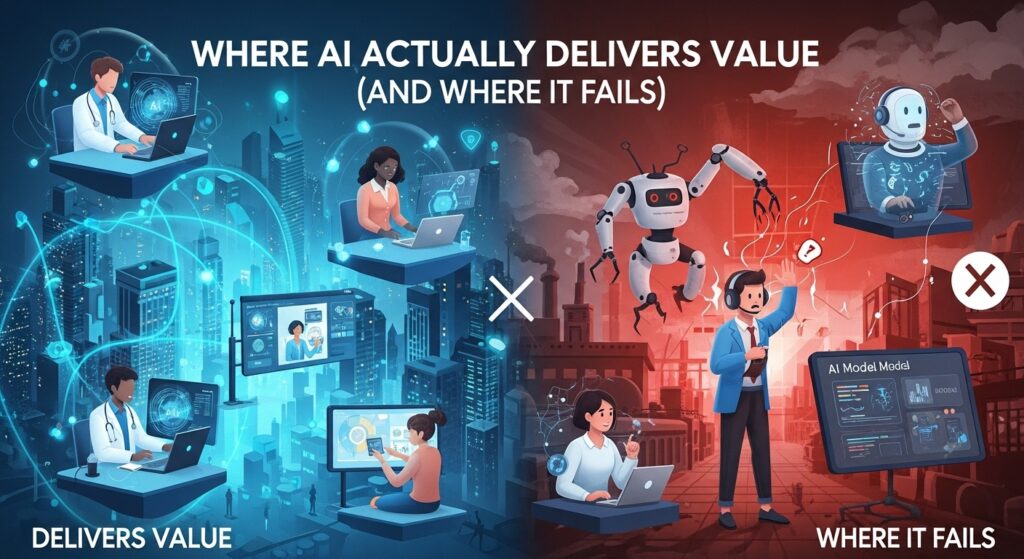
Not all AI applications are created equal. Some use cases are game-changers; others are money pits. Here’s where AI actually works and where it falls short.
AI Wins: High-Impact Use Cases
- Predictive Maintenance in Manufacturing
- How it works: Sensors collect real-time data from machinery, and AI predicts when a part is likely to fail.
- Real-world example: Siemens uses AI to monitor its gas turbines, reducing unplanned downtime by 50%.
- Why it works: The data is clean, the problem is well-defined, and the cost of failure is high.
- Dynamic Pricing in E-Commerce & Travel
- How it works: AI adjusts prices in real-time based on demand, competitor pricing, and customer behavior.
- Real-world example: Amazon changes prices millions of times a day. Airlines use AI to fill seats without slashing profits.
- Why it works: The variables (demand, supply, competition) are measurable, and the ROI is immediate.
- Fraud Detection in Finance
- How it works: AI analyzes transaction patterns to flag suspicious activity faster than humans.
- Real-world example: PayPal’s AI detects fraud with 99% accuracy, saving millions in chargebacks.
- Why it works: The data is structured, the patterns are detectable, and the cost of false negatives (missed fraud) is high.
- Personalized Marketing at Scale
- How it works: AI segments customers and tailors messaging based on behavior, not just demographics.
- Real-world example: Netflix’s recommendation engine drives 80% of viewer activity.
- Why it works: The feedback loop (what users watch/click) is immediate and measurable.
AI Fails: Overhyped or Misapplied Use Cases
- AI for Strategic Decision-Making
- The promise: “Our AI will tell you which markets to enter, which products to launch, and when to pivot.”
- The reality: AI can analyze data, but it can’t account for geopolitical shifts, cultural trends, or black swan events (like a pandemic).
- Example: A CPG company used AI to predict the next big snack trend. The AI suggested “seaweed chips” based on search data, but ignored the fact that most people who searched for them were just curious, not buyers.
- AI-Powered Customer Service (Without Human Backup)
- The promise: “Our chatbot will handle 90% of customer inquiries, 24/7.”
- The reality: Most chatbots struggle with complex or emotional issues. Customers get frustrated, and brand loyalty suffers.
- Example: A telecom company replaced its call center with an AI bot. Customer satisfaction scores dropped 30%, and churn increased.
- AI for Creative Work (Without Human Oversight)
- The promise: “Our AI will write your ads, design your logos, and even compose music.”
- The reality: AI-generated content often lacks originality, emotional depth, or brand voice.
- Example: A marketing agency used AI to generate social media posts. The content was grammatically correct, but the tone-deaf one post about a product launch read as if a robot wrote it (because it did).
- AI for Hiring & HR
- The promise: “Our AI will eliminate bias and find the perfect candidates.”
- The reality: AI hiring tools often inherit biases from historical data. Amazon’s AI hiring tool famously downgraded resumes with the word “women’s” (e.g., “women’s chess club”).
- Example: A tech company used AI to screen resumes and ended up rejecting qualified candidates because the AI penalized gaps in employment even if those gaps were due to parental leave or illness.
The Human Factor: Why AI Can’t Replace Judgment (Yet)
AI is a powerful tool, but it’s not a substitute for human expertise. Here’s why:
1. AI Lacks Context
AI makes decisions based on patterns in data, but it doesn’t understand why those patterns exist.
Example: An AI-powered supply chain system might notice that sales of a product spike in August and recommend stocking up. But if that spike is due to a one-time event (like a viral TikTok trend), the AI won’t know to adjust for the following year.
2. AI Struggles with Ethics & Bias
AI doesn’t have a moral compass. It reflects the biases in its training data.
Example: A healthcare AI trained on historical patient data might recommend fewer treatments for Black patients because, historically, they’ve received less care. The AI isn’t racist, it’s just mirroring past inequities.
3. AI Can’t Handle the Unexpected
AI excels at pattern recognition but fails when faced with novel situations.
Example: During the COVID-19 pandemic, many AI-driven demand forecasting models broke down because they’d never seen a global supply chain disruption of that scale. Companies that relied solely on AI were left scrambling.
4. AI Doesn’t Understand “Why.”
Humans ask why something happens. AI just observes what happens.
Example: An AI might notice that customers who buy Product A also buy Product B 70% of the time. But it won’t know whyis it because they’re complementary? Or is it just a coincidence? A human analyst can dig deeper.
The Ethical & Operational Risks You’re Probably Ignoring
AI isn’t just a technical challenge; it’s a business risk. Here are the biggest threats most companies overlook:
1. Regulatory & Compliance Risks
- GDPR & Data Privacy: If your AI is trained on customer data, you could be violating privacy laws.
- Bias & Discrimination: AI hiring tools, lending algorithms, and facial recognition systems have all been found to discriminate. The legal fallout can be severe.
- Explainability: In industries like finance and healthcare, regulators are demanding that AI decisions be explainable. If your AI is a “black box,” you could face fines.
2. Reputation Risks
- AI Hallucinations: AI models sometimes generate false information (e.g., a chatbot making up fake product specs).
- Tone-Deaf Automation: AI-generated marketing that feels impersonal or creepy can damage brand trust.
- Job Displacement Backlash: If you automate too many roles too quickly, you risk alienating employees and customers.
3. Operational Risks
- Over-Reliance on AI: If your team stops questioning AI recommendations, you become vulnerable to blind spots.
- Vendor Lock-In: Many AI solutions are proprietary. If your vendor raises prices or goes out of business, you’re stuck.
- Security Vulnerabilities: AI systems can be hacked. In 2023, researchers found that adversarial attacks could trick AI models into making wrong decisions.
A Practical Framework for Integrating AI Without Self-Destructing
So, how do you adopt AI responsibly? Here’s a step-by-step approach based on what’s worked (and failed) in real companies.
Step 1: Start with a Problem, Not a Solution
Don’t: “We need AI to find a use case.”
Do: “We have a problem, can AI solve it?”
Example: A manufacturing client wanted AI for “predictive analytics.” After digging deeper, we found their real issue was unplanned downtime. AI was a good fit, but only after we defined the problem clearly.
Step 2: Audit Your Data
- Is your data clean, structured, and relevant?
- Do you have enough data to train an AI model?
- Are there biases in your data that could skew results?
Pro Tip: If your data is messy, fix that before investing in AI. Otherwise, you’re just automating bad decisions.
Step 3: Run a Pilot (Not a Full Rollout)
- Start small. Test AI on a single process or department.
- Measure results against a control group.
- Be prepared to pivot or kill the project if it’s not working.
Example: A retail client wanted AI-powered dynamic pricing. Instead of rolling it out across all products, they tested it on a single category (electronics). The pilot worked, so they expanded.
Step 4: Keep Humans in the Loop
- AI should assist decision-making, not replace it.
- Assign a team to monitor AI outputs and intervene when needed.
- Train employees on how to work with AI, not against it.
Example: A bank using AI for loan approvals had human underwriters review the AI’s top 10% and bottom 10% of recommendations. This caught errors before they became costly.
Step 5: Plan for Continuous Improvement
- AI models degrade over time. Retrain them regularly.
- Monitor for bias, drift, and performance decay.
- Stay updated on regulations and ethical best practices.
Example: A logistics company retrained its route optimization AI every quarter to account for new traffic patterns and fuel costs.
Step 6: Prepare for the Worst
- What if the AI fails? Have a backup plan.
- What if customers hate it? Be ready to roll back.
- What if regulators crack down? Ensure compliance from day one.
Example: A healthcare provider using AI for diagnostics had a manual review process in place in case the AI made a mistake. This saved them from a potential malpractice lawsuit.
Final Thoughts: AI Is a Tool, Not a Strategy
AI-driven business strategy isn’t about replacing humans with machines. It’s about using AI to do what it does best: processing data, spotting patterns, and automating repetitive tasks so humans can focus on what they do best: creativity, judgment, and relationship-building.
The companies that succeed with AI aren’t the ones that adopt it the fastest; they’re the ones that adopt it thoughtfully. They start with a problem, not a solution. They invest in data quality. They keep humans in the loop. And they’re prepared for the risks.
If you take one thing away from this article, let it be this: AI is not a strategy. It’s a tactic that should serve your business goals, not define them.
FAQs About AI-Driven Business Strategy
1. How much does it cost to implement AI in a business?
Costs vary widely. A simple AI chatbot might cost $10,000–$50,000, while a full-scale predictive analytics system can run into the millions. The biggest expenses are usually data cleaning, integration, and ongoing maintenance, not the AI itself.
2. How long does it take to see ROI from AI?
For well-defined use cases (like fraud detection or predictive maintenance), ROI can come in 6–12 months. For more complex applications (like AI-driven product development), it may take 2–3 years.
3. What’s the biggest mistake companies make with AI?
Assuming AI is a “set it and forget it” solution. AI requires continuous monitoring, retraining, and human oversight.
4. Can small businesses benefit from AI?
Absolutely. Many AI tools (like chatbots, dynamic pricing software, and automated marketing platforms) are affordable and scalable for SMBs.
5. How do I know if my business is ready for AI?
Ask yourself:
- Do I have a clear problem AI can solve?
- Do I have clean, structured data?
- Do I have the budget for implementation and maintenance?
- Do I have buy-in from leadership and employees?
If the answer to all four is “yes,” you’re ready.
6. What industries benefit the most from AI?
- Finance: Fraud detection, algorithmic trading, risk assessment.
- Healthcare: Diagnostics, personalized treatment, drug discovery.
- Retail: Dynamic pricing, recommendation engines, and inventory management.
- Manufacturing: Predictive maintenance, quality control, supply chain optimization.
- Marketing: Personalization, ad targeting, customer segmentation.
7. What are the ethical concerns with AI in business?
- Bias: AI can perpetuate discrimination if trained on biased data.
- Privacy: AI often relies on personal data, raising GDPR and CCPA concerns.
- Transparency: Many AI models are “black boxes,” making it hard to explain decisions.
- Job Displacement: Automation can lead to layoffs if not managed responsibly.
8. How can I reduce bias in AI models?
- Use diverse training data.
- Audit models for bias before deployment.
- Include human reviewers in decision-making.
- Regularly retrain models with new data.
9. What skills do employees need to work with AI?
- Data literacy: Understanding how to interpret AI outputs.
- Critical thinking: Knowing when to question AI recommendations.
- Collaboration: Working alongside AI tools, not against them.
- Ethics training: Recognizing bias and privacy risks.
10. What’s the future of AI in business?
- More explainable AI: Regulators will demand transparency.
- AI + human hybrid models: The best results will come from collaboration, not replacement.
- Edge AI: AI running on local devices (like smartphones) for faster, more private processing.
- AI governance: Companies will need dedicated teams to oversee AI ethics and compliance.
Final Word: Proceed with Caution (and Curiosity)
AI is here to stay, and its potential is enormous. But like any powerful tool, it can do as much harm as good if wielded carelessly. The businesses that thrive with AI won’t be the ones that chase the latest trends; they’ll be the ones that ask the right questions, start small, and never lose sight of the human element.
So before you dive in, ask yourself: Is AI the right tool for this job? And if so, how can I use it responsibly?

Related Posts