
Walking through the headquarters of any major corporation today feels fundamentally different from it did just five years ago. The buzz isn’t just about quarterly earnings or market expansion anymore; it’s about machine learning models, predictive analytics, and automated workflows. After spending nearly a decade consulting with businesses on technology adoption, I’ve witnessed firsthand how artificial intelligence has shifted from a futuristic concept to an operational necessity.
But here’s what most industry reports won’t tell you: the companies succeeding with AI aren’t necessarily the ones with the biggest budgets or the flashiest technology. They’re the ones who understand that AI innovation isn’t about replacing human judgment, it’s about amplifying it.
The Current State of AI in Business Operations
Let me paint you a picture of what’s actually happening on the ground. Last month, I visited a mid-sized manufacturing company in Ohio that had implemented computer vision systems for quality control. Their defect detection rate improved by 340%, but the real story was in the details. The system didn’t replace their quality inspectors; instead, it flagged potential issues that human eyes might miss during eight-hour shifts, especially toward the end when fatigue sets in.
This mirrors a broader pattern I’m seeing across industries. Financial institutions are using natural language processing to analyze thousands of contracts in minutes that would take legal teams months to complete. Retail chains deploy recommendation engines that genuinely understand customer preferences, not just their purchase history. Healthcare providers leverage diagnostic AI that catches early-stage conditions in medical imaging with remarkable accuracy.
The numbers back this up. Recent data shows that businesses implementing AI solutions report average productivity gains of 40% in the specific processes where it’s applied. Yet, paradoxically, employment in these sectors hasn’t plummeted. It’s shifted and, in many cases, expanded into new roles we didn’t anticipate.
Where AI Actually Creates Value:
Through my work with dozens of companies, I’ve identified three areas where AI consistently delivers measurable results:
Predictive Maintenance and Operations
A food processing plant where I worked last year implemented IoT sensors, coupled with machine learning algorithms, to predict equipment failures. They reduced unexpected downtime by 35% and saved roughly $2 million annually. The key wasn’t just the technology; it was training their maintenance team to effectively interpret and act on the AI’s predictions.
Customer Experience Enhancement
One of my retail clients deployed conversational AI for customer service, but they learned something crucial: customers still wanted human interaction for complex issues. So they created a hybrid model where AI handles routine inquiries (tracking orders, return policies) while seamlessly escalating emotional or complicated cases to human agents. Customer satisfaction scores actually increased by 28%, and their human agents reported higher job satisfaction because they dealt with more meaningful interactions.
Data-Driven Decision Making
Perhaps the most transformative application I’ve witnessed is in strategic planning. A logistics company I advised uses AI to optimize routing, considering factors like weather patterns, traffic data, fuel prices, and driver availability. The system processes millions of variables that would be impossible for humans to analyze comprehensively. However, the final decisions still require human oversight to account for factors the AI might not consider, like maintaining relationships with key clients or navigating local regulations.
The Hidden Challenges Nobody Talks About
Now, let’s address the elephant in the room. For every success story, there are cautionary tales that rarely make headlines.
Data quality remains a massive hurdle. I’ve seen companies invest millions in sophisticated AI systems only to discover their historical data is inconsistent, incomplete, or biased. One financial services firm had to delay its AI lending platform by 18 months because its training data inadvertently perpetuated historical lending biases.
There’s also the integration nightmare. Most businesses run on a patchwork of legacy systems that weren’t designed to communicate with modern AI platforms. A manufacturing client spent three times their initial AI budget just making their existing systems compatible.
The skills gap is real and growing. Finding professionals who understand both the business domain and AI technology is like finding unicorns. Companies often have to choose between data scientists who don’t understand their industry or industry experts who don’t grasp AI’s capabilities and limitations.
Building an AI-Ready Organization:
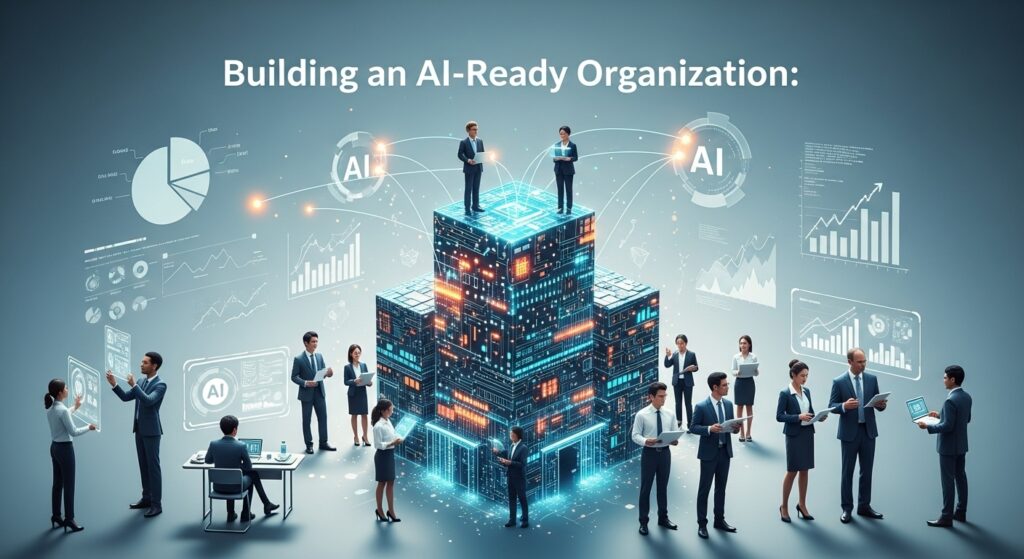
Based on my experience, successful AI adoption follows a pattern:
Start small with pilot projects that address specific, measurable problems. One insurance company began by automating just one type of claim assessment. Once they proved the concept and refined their approach, they expanded gradually.
Invest heavily in change management. The technology is only half the equation, maybe less. Employees need to understand how AI will change their roles, not replace them. Create internal champions who can bridge the gap between technical teams and business units.
Develop clear governance frameworks. Who’s responsible when an AI system makes an error? How do you ensure algorithmic decisions remain ethical and legal? These questions need answers before, not after, implementation. Focus on augmentation, not automation. The most successful implementations I’ve seen treat AI as a powerful tool that enhances human capabilities rather than a replacement for human workers.
Looking Ahead
The pace of AI innovation shows no signs of slowing. Generative AI has opened new possibilities for content creation, design, and even coding. Edge computing is bringing AI capabilities directly to devices, enabling real-time processing without cloud dependency.
But perhaps the most significant shift I’m observing is in mindset. Businesses are moving past the “AI will solve everything” phase into a more mature understanding of its role as a transformative tool that requires thoughtful implementation, continuous refinement, and human oversight.
The companies that will thrive aren’t those that adopt AI fastest, but those that adopt it most thoughtfully, ensuring it aligns with their values, enhances their workforce, and ultimately serves their customers better.
FAQs
Q: What’s the minimum budget needed to implement AI in business?
A: Starting costs vary wildly, but small pilot projects can begin with $50,000-100,000, while enterprise-wide implementations often exceed $1 million.
Q: How long does it take to see ROI from AI investments?
A: Most companies report initial returns within 12-18 months for focused projects, though enterprise-wide transformations may take 3-5 years.
Q: What industries benefit most from AI adoption?
A: Financial services, healthcare, retail, and manufacturing currently see the highest returns, though every industry has potential applications.
Q: Do employees generally resist AI implementation?
A: Initial resistance is common, but proper communication and training usually convert skeptics, especially when they see AI handling tedious tasks.
Q: What’s the biggest mistake companies make with AI?
A: Underestimating the importance of data quality and overestimating AI’s ability to work independently without human oversight.

Related Posts