
Let me be straight with you, when I first started helping small and mid-sized businesses integrate AI software into their daily operations, I thought it was all hype. Chatbots answering customer questions? Sure. Predictive analytics forecasting sales? Okay, maybe. But automating HR decisions or dynamically adjusting pricing in real-time? That felt like sci-fi.
Five years later, I’ve sat in boardrooms, debugged failed pilot programs, celebrated unexpected wins, and watched companies quietly transform not because they bought the shiniest AI tool on the market, but because they chose wisely, implemented patiently, and managed expectations realistically.
So if you’re a business owner, team lead, or curious exec wondering whether AI software is worth your time (and budget), here’s what I’ve learned: no fluff, no vendor jargon, just grounded insights from the trenches.
Why Companies Actually Adopt AI Software (Beyond the Buzzwords)
Most companies don’t adopt AI to “be innovative.” They adopt it because they’re drowning.
- Customer service teams are overwhelmed by 3 AM support tickets.
- Sales leads are slipping through cracks because nobody has time to follow up.
- Marketing campaigns that feel like throwing spaghetti at the wall.
- HR is drowning in résumés while good candidates ghost them.
Enter AI software not as some magic wand, but as a tireless, pattern-recognizing, data-crunching assistant that doesn’t need coffee breaks. Take Zapier + OpenAI integrations, for example. One e-commerce client of mine automated personalized post-purchase emails using customer purchase history and browsing behavior. Result? A 22% bump in repeat purchases within three months without hiring another copywriter.
Or consider HR tools like Pymetrics or HireVue, which use AI to screen early-stage applicants based on cognitive and emotional traits rather than just résumé keywords. Controversial? Yes. Effective? Also, yes, if calibrated ethically and monitored for bias.
The Real Categories of AI Software Businesses Use (Not Just ChatGPT)
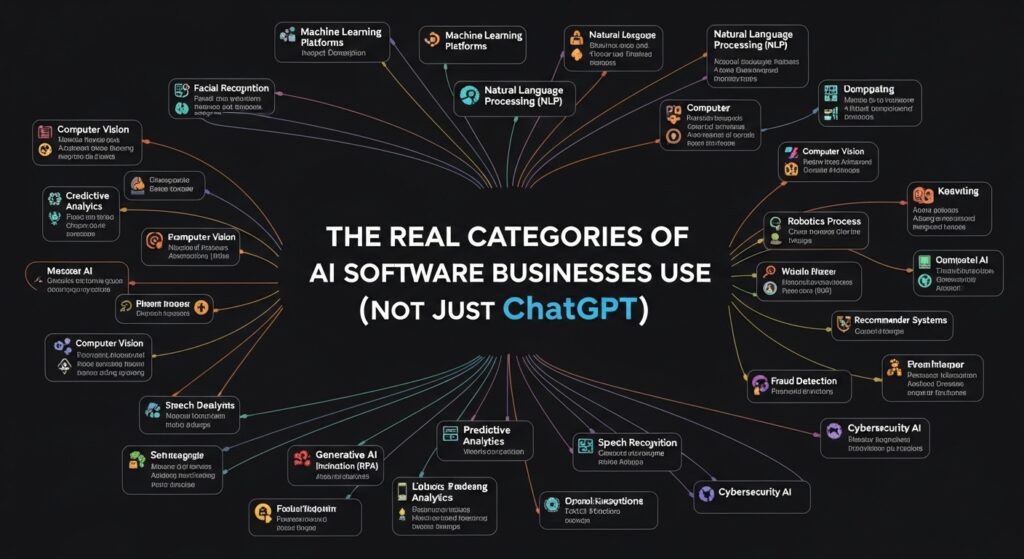
There’s more to AI than chatbots and image generators. Here’s how companies are actually deploying it:
1. Customer Experience & Support
Tools like Zendesk Answer Bot, Intercom Fin, or Ada learn from past tickets and knowledge bases to resolve common queries instantly. One SaaS startup I consulted for cut its Tier 1 support load by 40%, freeing humans to handle complex escalations.
Pro tip: Don’t fully automate sensitive issues (billing disputes, cancellations). AI should assist, not alienate.
2. Sales & Lead Prioritization
Platforms like Gong, Clari, or Salesforce Einstein analyze call transcripts, email threads, and CRM activity to predict which deals are most likely to close and coach reps on what to say next. I watched a B2B sales team double their conversion rate after Einstein flagged that prospects who asked about integration timelines were 3x more likely to buy. Simple insight. Huge impact.
3. Marketing Personalization
Tools like Dynamic Yield (now part of Mastercard) or Optimizely let brands serve hyper-personalized content, product recommendations, or even pricing based on user behavior. Sephora’s AI-driven skincare quiz? That’s not gimmicky; it drives 35% of their online conversions.
4. Operations & Forecasting
Retailers use Blue Yonder or ToolsGroup to predict inventory needs down to the SKU level. Manufacturers deploy Seebo or Augury to predict machine failures before they happen. One food distributor slashed waste by 18% just by better predicting regional demand spikes.
5. HR & Talent Management
From Textio (which optimizes job descriptions for inclusivity) to Eightfold AI (which maps internal mobility paths), HR teams are quietly revolutionizing retention and DEI if they avoid algorithmic bias traps.
The Ugly Truths Nobody Talks About
AI isn’t plug-and-play. And vendors won’t tell you this:
- Garbage in, gospel out. If your data is messy, siloed, or outdated, your AI will make confident, expensive mistakes. Clean your data before buying the tool.
- Integration headaches are real. That slick AI dashboard won’t help if it can’t talk to your legacy ERP or CRM. Budget for middleware or developer time.
- Your team might resist it. Not because they’re Luddites, but because they’re afraid of being replaced. Involve them early. Train them. Make them co-pilots, not passengers.
- ROI takes time. Most AI projects break even in 6–12 months. If your CFO demands instant ROI, start smaller, maybe with an AI writing assistant for marketing copy, before tackling predictive supply chains.
How to Choose the Right AI Software (Without Getting Scammed)

After evaluating over 60 tools for clients, here’s my checklist:
Does it solve a specific pain point? Avoid “AI for AI’s sake.” Start with: “What’s keeping us up at night?” Then find the tool that fixes that.
Is it explainable? Can the vendor show you how it reaches decisions? If it’s a black box, walk away, especially in HR, finance, or compliance-heavy industries.
What’s the implementation timeline? If they promise “go live in 48 hours,” they’re either lying or selling vaporware. Real integration takes weeks, sometimes months.
Who owns the data? Read the fine print. Some vendors train their models on your data. Make sure you’re comfortable with that.
Is there human oversight built in? The best AI tools include dashboards for auditing, flagging anomalies, and overriding decisions. No responsible company runs AI fully autonomously.
Ethical Considerations You Can’t Ignore
AI isn’t neutral. It reflects the data it’s fed and the biases of its creators.
- Bias in hiring algorithms? ProPublica exposed this years ago. Audit your tools. Demand transparency reports.
- Surveillance creep? Employee monitoring AI (like Time Doctor or ActivTrak) can boost productivity or destroy trust. Use sparingly. Be transparent.
- Environmental cost? Large AI models consume massive energy. Ask vendors about their carbon footprint. Some, like Hugging Face, now publish sustainability metrics.
Ethics isn’t a sidebar; it’s core to sustainable AI adoption.
Where This Is Headed (And How to Prepare)
We’re moving from “AI as tool” to “AI as teammate.”
- Agentic workflows: Soon, AI won’t just respond, it’ll initiate. Imagine an AI that notices your website conversion drop, diagnoses why, drafts a fix, and asks for your approval to deploy it.
- Vertical-specific AI: Generic tools are giving way to industry-tailored solutions, AI for law firms, AI for construction logistics, and AI for indie record labels.
- Regulation is coming. The EU AI Act is just the beginning. Start documenting your AI use cases now. Compliance will be easier if you’re already transparent.
Final Thought: Start Small, Think Big
You don’t need to overhaul your entire operation. Pick one bottleneck. Test one tool. Measure results. Iterate.
One bakery owner I know started by using ChatGPT to draft social media captions. Then moved to an AI scheduler for staff rosters. Now? She’s testing dynamic pricing for her sourdough loaves based on weather, foot traffic, and flour costs. She didn’t become an AI guru overnight. She became smarter, step by step. That’s the real power of AI software for companies, not replacing humans, but amplifying them.
FAQs
Q: Do I need a data scientist to use AI software?
A: Not anymore. Many tools are no-code or low-code. But you do need someone who understands your business data.
Q: How much does AI software cost?
A: From $20/user/month (like Jasper for content) to $50K+/year for enterprise platforms. Start small; many offer free trials.
Q: Is my industry too niche for AI?
A: Unlikely. Even vineyards and funeral homes are finding use cases. Look for workflow bottlenecks; that’s where AI shines.
Q: Will AI replace my employees?
A: It might replace tasks, not people. The goal is augmentation, letting your team focus on creative, strategic, human-centric work.
Q: What’s the biggest mistake companies make with AI?
A: Buying before defining the problem. AI is a solution, but only if you know what you’re solving.

Related Posts