
If you’ve spent any time in boardrooms, data teams, or even just browsing business news lately, you’ve probably noticed the buzz around AI analytics tools. These aren’t just another fleeting trend; they’re fundamentally reshaping how organizations extract value from their data.
As someone who’s spent years working with analytics platforms, implementing machine learning models, and guiding teams through digital transformation, I can say with confidence: AI analytics tools are not just about pretty dashboards or automating spreadsheets. They’re about making sense of chaos, surfacing hidden patterns, and enabling smarter, faster decisions.
Let’s dive into what AI analytics tools really are, how they work, why they matter, and what to consider when choosing one for your organization.
What Are AI Analytics Tools?
At their core, AI analytics tools are software platforms that leverage artificial intelligence think machine learning, natural language processing, and deep learning, to analyze data, generate insights, and even recommend actions.Unlike traditional analytics, which often require manual data wrangling and statistical expertise, AI analytics tools aim to make advanced analysis accessible to a broader audience. They can ingest vast, diverse datasets, automatically detect trends, anomalies, and correlations, and often deliver results in a way that non-technical users can understand.
For example, imagine a retail company trying to understand why sales dipped in a specific region last quarter. Instead of poring over spreadsheets, a business analyst could use an AI analytics tool to upload sales data, let the system identify contributing factors (like seasonality, local events, or competitor actions), and receive a plain-language summary with actionable recommendations.
How Do AI Analytics Tools Work?
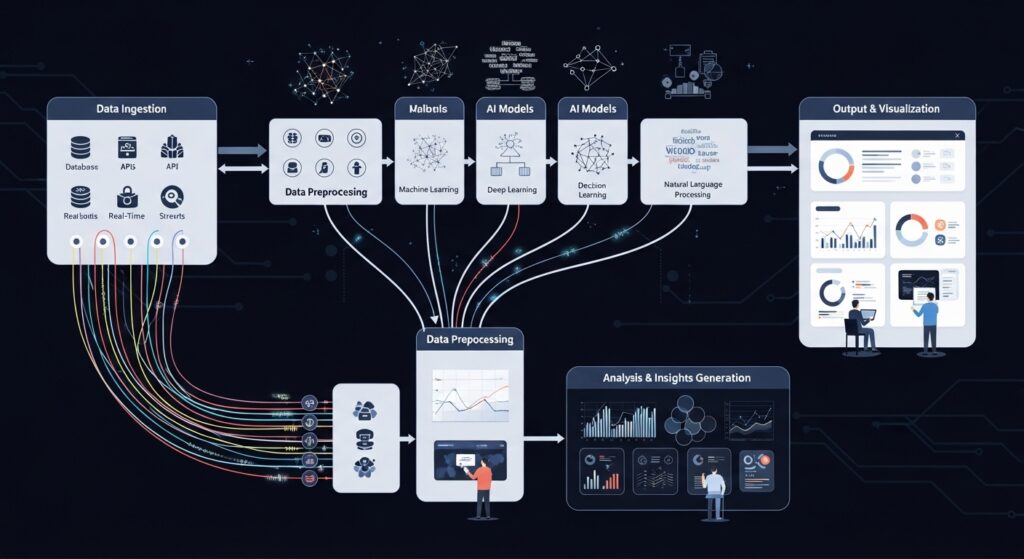
AI analytics tools combine several technologies under the hood:
- Data Ingestion and Preparation: They can connect to various data sources, databases, cloud storage, APIs, and even unstructured text or images. Many use automated data cleaning and transformation, drastically reducing the prep work that used to take days or weeks.
- Machine Learning Models: These tools often include built-in algorithms for classification, clustering, forecasting, sentiment analysis, and more. Some offer pre-built models, while others allow for custom model training.
- Natural Language Processing (NLP): For organizations dealing with customer feedback, support tickets, or social media data, NLP capabilities can summarize sentiment, extract key phrases, or even categorize issues automatically.
- Visualization and Reporting: Results are presented through interactive dashboards, visualizations, or even conversational interfaces (think chatbots that answer questions about your data).
- Automation and Alerts: Some tools can proactively flag anomalies or send alerts when key metrics drift, enabling organizations to respond in real time.
Real-World Applications and Case Studies:
Let’s look at a few practical scenarios where AI analytics tools are making a tangible difference:
1. Customer Churn Prediction in Telecom
A telecom company was losing customers at an alarming rate and struggling to identify which subscribers were most likely to churn. By implementing an AI analytics platform, they fed in call records, billing data, customer service interactions, and social media sentiment.
The system identified patterns that correlated with churn, such as repeated billing disputes or poor network performance in certain areas, and automatically flagged at-risk customers. The company could then proactively offer discounts or targeted customer service interventions, reducing churn by 15% within six months.
2. Predictive Maintenance in Manufacturing
A mid-sized manufacturer was dealing with costly unplanned downtime on their production lines. By connecting sensor data from machines to an AI analytics solution, the system learned the normal operating patterns and could predict when equipment was likely to fail based on subtle changes in vibration, temperature, or sound. Maintenance could be scheduled proactively, reducing downtime by over 30% and saving hundreds of thousands in lost productivity and emergency repairs.
3. Sentiment Analysis for Product Development
A consumer goods company used an AI analytics tool with NLP to analyze thousands of customer reviews and social media comments. The tool automatically grouped feedback into themes like packaging, taste, or value for money, and highlighted emerging issues and positive trends. Product managers could then quickly prioritize improvements or double down on what was working, dramatically shortening their product iteration cycles.
Key Benefits of AI Analytics Tools
From my experience, the biggest advantages of adopting AI analytics tools include:
- Faster Insight Generation: What used to take weeks can now take hours. Automated analysis surfaces insights that might have been missed by manual methods.
- Democratization of Data: Non-technical users can ask questions of their data and get understandable answers. This empowers teams across the organization, not just data scientists.
- Proactive Decision-Making: Instead of reacting to problems after the fact, organizations can anticipate issues and spot opportunities early.
- Scalability: These tools can handle massive datasets from multiple sources, making them ideal for modern enterprises with sprawling data landscapes.
- Cost Efficiency: By automating repetitive tasks and reducing the need for specialized data staff for every analysis, companies can do more with less.
Limitations and Challenges
However, AI analytics tools are not a silver bullet. There are real limitations and pitfalls to keep in mind:
- Data Quality Matters: Garbage in, garbage out. If your data is incomplete, biased, or inaccurate, the insights will be, too.
- Interpretability: Some AI models, especially deep learning ones, can be “black boxes.” Understanding why the system made a particular recommendation isn’t always straightforward, which can be a problem in regulated industries.
- Skill Gap: While these tools are designed to be user-friendly, getting the most out of them still requires some level of analytics literacy. Overreliance without understanding the underlying data can lead to bad decisions.
- Integration Complexity: Connecting these tools to legacy systems or proprietary data sources can be technically challenging.
- Cost and Vendor Lock-In: Enterprise-grade AI analytics platforms can be expensive, and migrating between vendors may be costly and time-consuming.
- Ethical and Privacy Concerns: Using AI to analyze sensitive data (like customer behavior or employee performance) raises questions about consent, bias, and compliance with regulations such as GDPR or CCPA.
How to Choose the Right AI Analytics Tool
Selecting the right AI analytics platform depends on your organization’s specific needs, resources, and technical maturity. Here’s what I recommend considering:
- Business Objectives: Are you focused on customer analytics, operations, supply chain, or something else? Make sure the tool aligns with your use case.
- Data Sources and Integration: Can the tool connect to your existing data lakes, databases, and applications? Consider ease of integration and data movement costs.
- User Skill Levels: Do you need a solution for power users, or one that empowers business users with minimal training?
- Model Flexibility: Do you need out-of-the-box models, or the ability to build and deploy custom algorithms?
- Explainability and Reporting: How transparent are the results? Can the tool explain its findings in a business-friendly way?
- Scalability and Performance: Will the tool grow with your data and user base?
- Security and Compliance: Does it meet your organization’s data governance and regulatory requirements?
- Vendor Support and Community: Look for active support, documentation, and user communities to help with troubleshooting and best practices.
Popular tools in the market today include Microsoft Power BI with AI features, Google Cloud’s BigQuery ML, IBM Watsonx, Salesforce Einstein Analytics, Tableau with AI/ML extensions, and specialized platforms like DataRobot or Alteryx. Each has its strengths and weaknesses, so pilot programs and proof-of-concept projects are often worthwhile before making a big commitment.
The Future of AI Analytics Tools
AI analytics is still in a period of rapid evolution. I expect to see:
- Greater Automation: Tools will increasingly automate not just analysis, but also insight generation and even action recommendations.
- Explainable AI: As regulations and user expectations grow, there’ll be more focus on transparent, understandable AI models.
- Democratization and Natural Language Interfaces: Asking “Why did sales drop in Q2?” in plain English and getting a clear answer will become commonplace.
- Edge AI Analytics: More analysis will happen directly on devices, reducing latency and bandwidth needs.
- Integration with Workflow Automation: AI analytics won’t just inform decisions, they’ll trigger actions in other business systems automatically.
- But technology alone won’t drive value. Success depends on organizational culture, data quality, user adoption, and ethical oversight.
Final Thoughts: Getting Started with AI Analytics
AI analytics tools are no longer the exclusive domain of data scientists or tech giants. They’re accessible, powerful, and increasingly essential for any organization that wants to compete in a data-driven world. But they’re not magic wands. The real payoff comes from combining robust tools with thoughtful processes, skilled people, and a clear understanding of your business goals. If you’re considering adopting an AI analytics tool, start small.
Identify a high-impact business question, gather a cross-functional team, and run a pilot project. Focus on data quality, user training, and interpreting results in context. Build from there, iterating as you learn what works and what doesn’t.In the end, AI analytics tools are not just about crunching numbersvb they’re about empowering people to make better decisions, faster, with more confidence than ever before.
FAQs
What is an AI analytics tool?
An AI analytics tool is a software platform that uses artificial intelligence to analyze data, detect patterns, generate insights, and sometimes recommend actions, making advanced analytics accessible to a wider range of users.
Do I need programming skills to use AI analytics tools?
Most modern AI analytics tools are designed for users without great technical skills. Many offer drag-and-drop interfaces, natural language queries, and pre-built models. However, some understanding of data and analytics is still helpful for the best results.
What kinds of data can AI analytics tools handle?
They can process structured data (like spreadsheets or databases), unstructured data (like text, images, or audio), and often combine both. Many tools also support streaming data or data from multiple sources.
Are AI analytics tools secure?
Reputable platforms invest heavily in security, but you should always evaluate a tool’s compliance certifications, data encryption, access controls, and privacy policies to ensure they meet your organization’s needs.
How much do AI analytics tools cost?
Pricing varies widely depending on features, data volume, deployment model (cloud vs. on-premises), and number of users. Some tools offer pay-as-you-go pricing, while others require annual contracts. It’s important to factor in not just licensing, but also implementation and ongoing support costs.
Can AI analytics tools replace data scientists?
They can automate many routine tasks and make analytics more accessible, but complex problems and custom solutions still often require data science expertise. The best results come from combining AI tools with human judgment and creativity.

Related Posts